

Overview
Game Genre
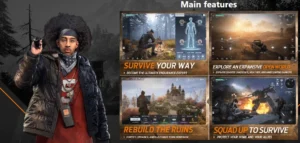
Large-scale Open-World Survival Crafting RPG
Engine
Unreal Engine 4.
Platforms
PC, iOS, and Android (with full data sharing between platforms)
Scope
Released everywhere globally at the same time.

Challenges & Solutions
Challenge 1: Proprietary Tooling & Language Barriers
The Problem:
The client used their own custom tools and test data setups, which were written completely in their native language. This made it very hard for our international team to set up the test environment and manage data, slowing down our start.
Our Solution:
We formed a special group of “Bridge QA” members who spoke both languages. They translated the tool interfaces and wrote easy, step-by-step guides to train the rest of the team.
We worked closely with the developers and used real-time screen translation tools so our team could learn the tools quickly without wasting time
Challenge 2: Extreme Hardware Fragmentation & Cross-Play Sync
The Problem:
The title demanded seamless, optimized performance across an immense hardware spectrum – ranging from high-end gaming PCs to budget smartphones. The core technical challenge lay in ensuring 100% real-time data synchronization between these vastly different platforms within a massive open world.
Our Solution:
Implemented a rigorous Device Compatibility Matrix, categorizing a massive device pool into distinct tiers based on SoC (Chipsets), RAM, and OS versions for both iOS and Android.
Designed advanced Cross-Play & Network Latency Simulation test scenarios (e.g., simulating packet loss, high ping, and seamless switching from Wi-Fi to 4G/5G) to strictly validate data synchronization of player positions, inventory states, and world interactions.
Challenge 3: Linguistic & UI Complexity (LQA)
The Problem:
Launching the game in many regions with many languages at once meant a high risk of text breaking or overlapping on the screen, words being translated out of context, or using terms that might offend local players.
Our Solution:
Pioneered a hybrid approach combining Semi-Automated LQA with Manual Verification. We developed internal scripts to capture bulk screenshots during dialogue flows, allowing rapid automated scanning for UI overlapping and text clipping.
Utilized Native-Speaking Linguistic Specialists to conduct deep contextual reviews, ensuring that survival-specific
terminology (crafting systems, items, lore) felt natural, consistent, and culturally respectful to local players.
Challenge 4: Massive Content Scope vs. Market Timing
The Problem:
The game world was huge, and there were too many stories and missions to test. Because the global release date was strict, we had a massive amount of things to check in a very short amount of time.
Our Solution:
We used a Risk-Based Strategy. We prioritized testing the most important parts first: the main gameplay, the cash shop/payment systems, and the main story missions.
We used Parallel Testing (Simultaneous Execution). Instead of testing one by one, we divided the massive map and
test cases into smaller, independent sections. Multiple QA sub-teams tested different parts of the game at the exact
same time using different test environments. This multiplied our testing speed and allowed us to cover the entire game within the strict deadline.
Scope of Work & Team Structure
Scope of Work
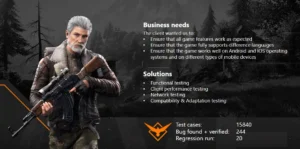
- Functional testing
- Client performance testing
- Localization testing
- Compatibility and Adaptability testing
Team Structure
- 1 QA Leader
- 5 QA Engineers
Business Impact
Launch Integrity
Delivered the project for global release on schedule without any technical delays.
Market Reach
Optimized performance for low-end hardware, allowing the client to capture a massive user base in emerging markets.
Stability
Achieved a 99.8% crash-free rate during the launch window, resulting in top-tier ratings on major App Stores.
Future Readiness
Provided a standardized suite of QA assets and tool guides to support long-term “Live-Ops” and seasonal content updates.