
Category: Manual Testing

To Know Deeply About Software Testing Through 8 Common Questions

Software testing is an important part of the entire software development life cycle. Through the testing phase, software defects can be identified early and remedied before final product delivery. Therefore, many software development companies focus on building strict testing processes and investing in in-house testing teams. This article will help you unlock the most common problems before diving in.

1. Why Software Testing is a MUST in every software development life cycle?

Software bugs can cause serious loss of money and people. Starbucks was forced to close about 60% of its stores in the United States and Canada, even serving free coffee because it was unable to process the transaction due to a software bug in its POS system. In 1994, China Airlines Airbus A300 crashed due to a software error, killing 264 people.

The examples above show that businesses can save up to millions per year, minimizing serious problems if they have a reliable and strict testing process. Besides, a software that is error-free and undergoes many rigorous quality checks will easily win the trust and satisfaction of customers; bring efficiency in both cost, security, as well as sustainable development.


2. How many types of Software testing?

Based on different criteria, we can classify Testing in many ways including:
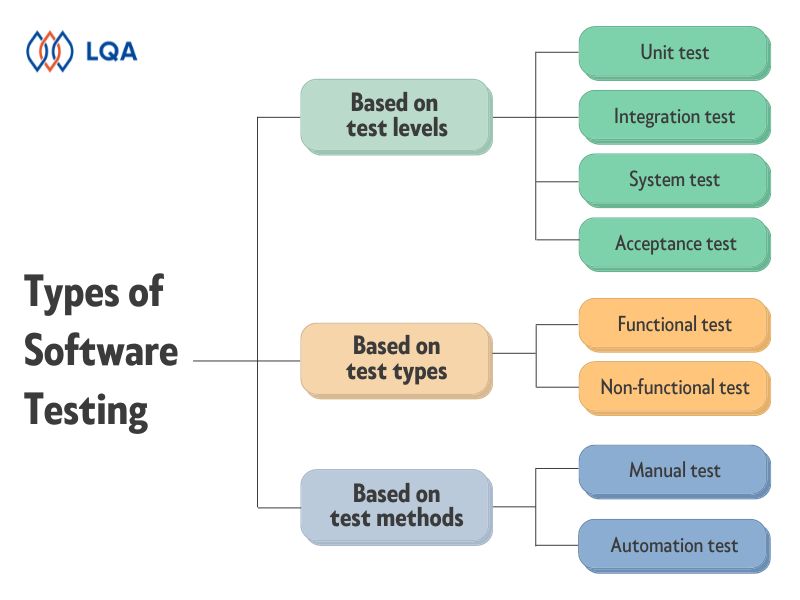
software testing types

How many types of software testing?

a. According to test levels

  • Unit testing: the process of testing corrections on an individual unit or component to assure that they work properly on their own. Unit testing is important because it enables us to find more defects at the unit test level, reduce wasted tests, and speed up testing strategies.
  • Integration tests: a level of software testing where two or more modules of an application are logically grouped and tested as a whole. The focus of this type is to search for the defect in communication, interface, and data flow among modules. A top-down or Bottom-up approach is used while integrating modules into the whole system. This type of testing is done by integrating modules of a system or between systems.
  • System Testing: a level of software testing that validates the complete and fully integrated software product. The purpose is to evaluate the end-to-end system specifications. Usually, the software is only one element of a larger computer-based system. Ultimately, the software is interfaced with other software/hardware systems. System Testing is defined as a series of different tests whose sole purpose is to exercise the full computer-based system.
  • Acceptance testing: ensures that the end-user (customers) can achieve the goals set in the business requirements, which determines whether the software is acceptable for delivery or not. It is also known as user acceptance testing (UAT). Acceptance testing is a type of testing where the client/business/customer test the software with real-time business scenarios. The client accepts the software only when all the features and functionalities work as expected. This is the last phase of testing, after which the software goes into production. This is also called User Acceptance Testing (UAT).

b. According to test types

  • Functional testing: a type of testing which verifies that each function of the software application operates in conformance with the requirement specification.
  • Non-functional testing: a type of testing to check non-functional aspects (performance, usability, reliability, etc.) of a software application.

c. According to test methods

  • Automation testing: a testing technique utilizing tools and test scripts to automate testing efforts. In other words, specified and customized tools are implemented in the testing process instead of solely manual forces.
  • Manual testing: the technique in which a tester/a QA executes the whole testing process manually, from writing test cases to implementing them. In manual testing, QA analysts carry out tests one-by-one in an individual manner to find bugs, glitches and key feature issues prior to the software application’s launch. As part of this process, test cases and summary error reports are developed without any automation tools.


3. Is Automation Testing the most popular and why?

Manual Testing has been the most popular method of the quality assurance process in general, yet it exposes some limitations that cause many businesses to become testing-ineffective.

Up until now, automated testing is considered a more innovative technique to boost the effectiveness, test coverage, and test execution speed in software testing. With this new “approach”, the testing process is expected to yield more test cases in a shorter amount of time and expand test coverage.

While it does not entirely exclude manual touch within the process, automation testing is a favorable solution for its cost-efficiency and limited human intervention. To put it in other words, automation testing requires manual efforts to make automation testing possible.

automation testing solutions

Is Automation Testing the most popular and why?

The 8 promising prospects of Automation Testing include:

  •  High yield of ROI
  • Consistent regression testing
  • Broad test coverage
  • Accuracy and Reliability
  • Faster pace
  • Developers and Testers unburdened
  • Reduce Human Intervention
  • Records of measure quality metrics

>> Learn more about From Manual to Automation Testing: Why Even Bother?


4. Manual Testing vs. Automation Testing comparison, and when to use each method?

Manual testing is the traditional and fundamental test method in software testing. We often use the manual method to test new products or when we don’t have a clear understanding of the products or when the systems haven’t become stable yet.

Automation testing is considered a high-tech test method in comparison to manual one. We often use this test method to reduce resources and time consumed for testing a system that is stably functioning and we already clearly know about it.

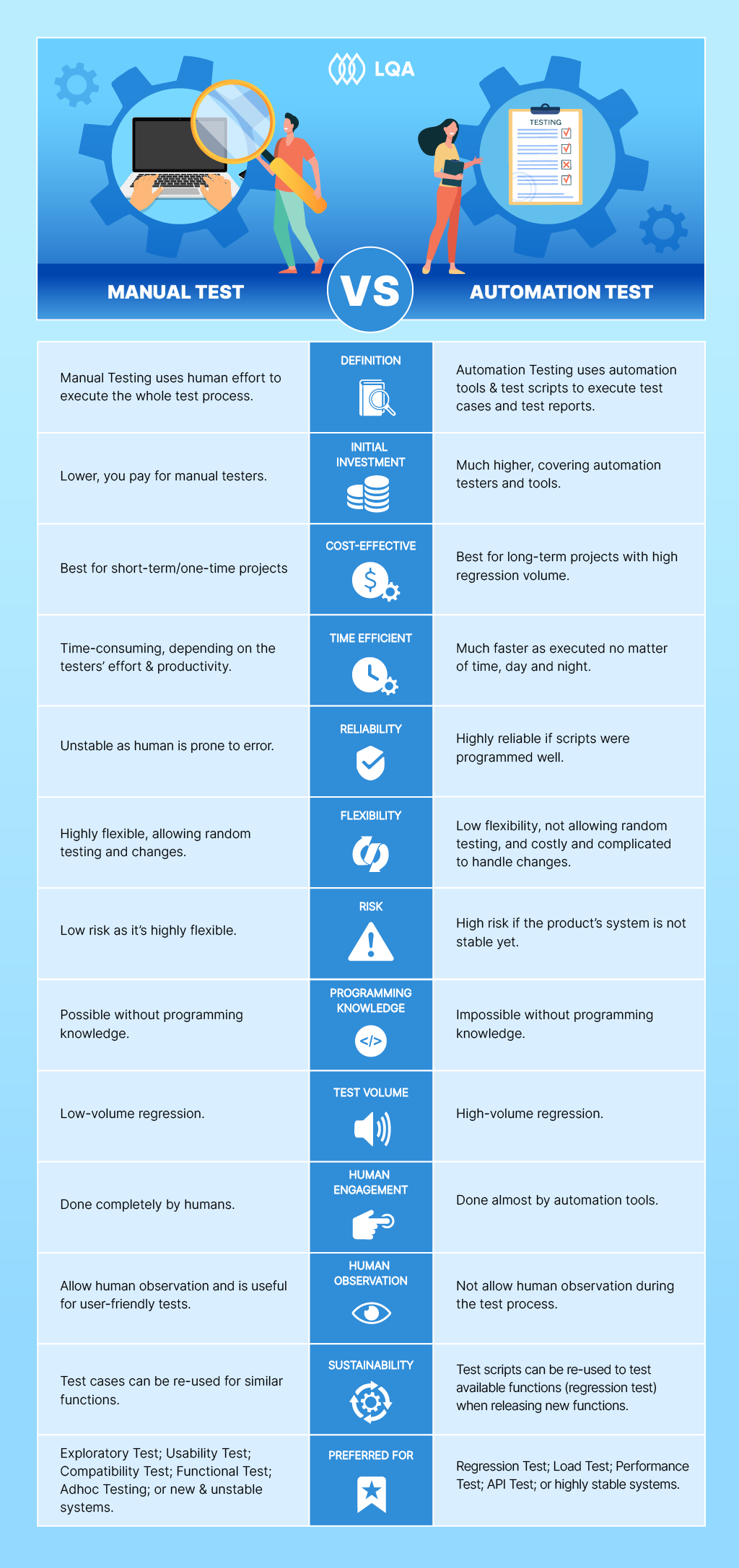
You can find a more specific comparison between Manual Testing and Automation Testing in this infographic.

manual testing and automation testing comaprison

Manual Testing vs. Automation Testing comparison, and when to use each method?


The answer of whether you should choose automation testing or manual testing depends on your situation.

Choose manual test if:

  • Your product is new and you don’t have experience with this kind of product before.
  • The AUT (Application under test) changes frequently.
  • You have a limited budget.
  • You want to ensure user-friendliness in the product.
  • You want to handle complex test cases.
  • Your team doesn’t have the tech ability (for any reason) to set up and maintain automation.

And choose automation test if:

  • There are repetitive tasks in a stable-functioning system and you want to reduce these tasks.
  • When your system has frequent releases and you want to decrease test cycle time to speed up the processes.
  • You have a great budget for building automation testing.
  • You consider the test ability is needed in a long-term period.
  • You want better transparency of testing activities. Statistics and graphs about the test process, performance, and error rates are explicitly indicated.

> Learn more about Which is the cost-effective solution for your firm?


5. Automotive test vs Automation test: Aren’t they the same?

Many people still misunderstand that Automotive testing is Automation testing. Therefore, to better understand Automotive testing, let’s distinguish those two concepts:

Automation testing – is a software testing method with an automated nature, precisely, the Tester only needs to write a piece of code or use some tools such as Selenium, Test Complete, and JMeter,… to run all the stages automatically, including entering information, clicking, checking results, comparing actual results with hypothetical results, etc., without having to perform manual operations over and over again.

Automotive testing – is the testing of embedded software written for embedded systems. Specifically, embedded software is software that is pre-installed by the device manufacturer into a product and that is utilized immediately with the electronic device without the need for the user or third-party installation. An Embedded system is a combination of hardware and software and here the software is embedded in the hardware.

automation testing and automotive testing comparison

Automotive test vs Automation test: Aren’t they the same?


6. What are the challenges and difficulties of building a software testing team and process?

High initial investment cost for human resources 

According to Payscale, based on the latest updates on Jan 04 2022, the average salary for a Software Tester is $56,468.

However, the investment cost for a Software Tester Engineer does not just stop at salary, but also includes the cost of recruitment, training and other employee benefits. The IT industry is currently facing a shortage of human resources; therefore, recruitment becomes extremely competitive among businesses. Software testers have a high chance of job hopping when they find a company with better benefits and salary. Employers have to invest a lot of money and effort for headhunt services to successfully recruit a quality employee.

In addition, Software Testers at different levels also have different salaries range. Below is the salary range of a Software Tester from Entry level to Experienced.
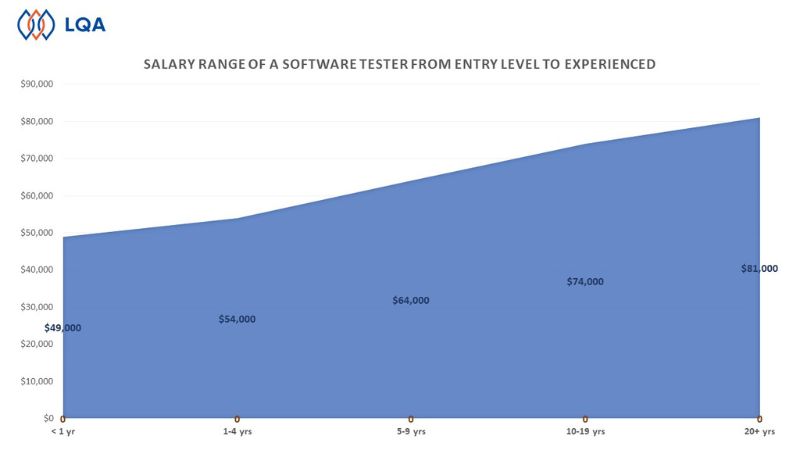
software testers salary range

Software Testers salary range

The costs listed above are only calculated for one employee. Try to do a quick calculation, multiply this number by 5 or more if you want to build an in-house testing team.

High initial investment cost for testing tools

Besides the investment in human resources, businesses will have to prepare a budget for both facilities and testing tools. If it’s automation testing then you will only need to set up your computer and buy testing tools. But if it is an embedded test, the enterprise will have to invest in more complicated and expensive testing machines such as CANoe and CANat equipment, … Not to mention, when it comes to Integration and system testing, it requires set up for different test environments.

Bias in Software Testing: How Do Testers Miss Bugs?

According to Psychology Today, a bias is a tendency, inclination, or prejudice toward or against something or someone. Some biases are positive and helpful—like choosing to only eat foods that are considered healthy or staying away from someone who has knowingly caused harm. But biases are often based on stereotypes, rather than actual knowledge of an individual or circumstance. Whether positive or negative, such cognitive shortcuts can result in prejudgments that lead to rash decisions or discriminatory practices.

bias in software testing

Bias in Software Testing: How Do Testers Miss Bugs?

One of the fundamentals of software testing; as referred to by the International Software Testing Quality Board (ISTQB); is that testing helps detection of defects. Taking into consideration that humans are an integral entity in software development, it is impossible to certify a 100% bug-free program when tests aren’t detecting any defects. Human testing detects and reduces the probability of undiscovered defects remaining in the software but even if no defects are found, it is not proof of perfection.

When the testers approach any testing, they are already influenced by their own biases – framing thoughts and judgments based on what to look for, where there would be potential defects coming up, who is developing it, the entire history of the program etc., and the list goes on.


7. In-House Software Testing vs. Outsourcing: What should you choose?

For the above challenges, many businesses choose to outsource software testing services. Because a flexible and quick team ramp-up/down on demands will bring benefits to businesses such as:

Cost-Effective and Time Efficient:

As mentioned above, effort, resources and investment costs for an in-house testing team are extremely expensive. Outsourcing a testing team will be the optimal choice to save the above investment costs. In particular, businesses can take advantage of low-cost labor when offshore outsourcing. For example, in Vietnam, the average salary of Software Test Engineer is $18633.55/year, 5 times lower than in the US and 6 times lower than in Japan (according to Salary expert data).

In addition, by outsourcing, your business can set up a testing team immediately, skipping the entire process of recruiting, training, setting up office equipment. An 24/7 available and flexible testing team that can ramp up or ramp down on demand. A team works independently, along with the in-house team to increase work efficiency and speed up time to market. Especially, when the demand for testing is huge due to continuously release, in-house QA team struggle to handle, offshore team can help optimize resource allocation. Your in-house team will not be overloaded and be able to focus on core business.
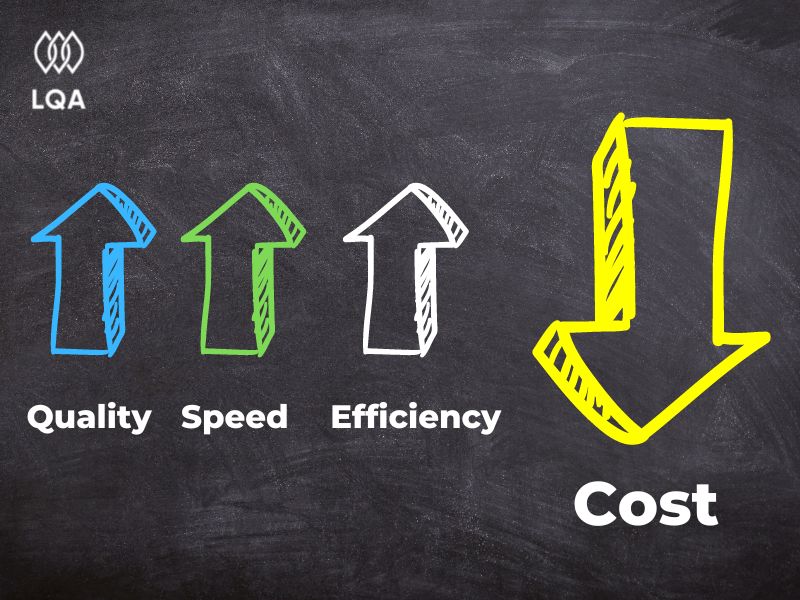
cost effectiveness when outsourcing software testing

Cost-Effective and Time Efficient when Outsourcing Software Testing


Access to larger pool of Expertise and quicker transformation to another test method

When outsourcing to another country, your business will expand its talent network. This will also make it much easier to switch testing methods or types. No need to compete with domestic enterprises to hunt for candidates, no time to research and train new methods. If you want to move from manual testing to automation testing to optimize testing effort and speed up time to market, why not outsource it?

For example, in Vietnam today, IT resources are growing in both quantity and quality. According to the latest report of TopDev, Vietnam currently has 1.03M IT labor force and 62,000 graduated IT students/year. The Vietnamese government also has policies to support the development of the IT industry and facilitate international cooperation.

Software Testing outsourcing to Vietnam

In Vietnam, there are also leading testing companies, meeting international standards. LQA is an example when it becomes a silver partner of ISTQB (International Software Testing Qualifications Board).

No bias and Fresh perspective:

As shared above, one of the challenges and disadvantages of in-house testing teams is bias. To solve this problem, businesses can ask a 3rd party to cross-evaluate the quality of the product. From there, compare with the results of the in-house team to get the most objective result. Eliminating the trails of in-house testers and approaching fresh perspectives is the special benefit that offshore testing teams bring to businesses.

Below is a comparison table of the most basic criteria between Offshore Software Outsourcing Testing and In-house Software Testing. Businesses can rely on this assessment to choose the most optimal model for their needs at this time.
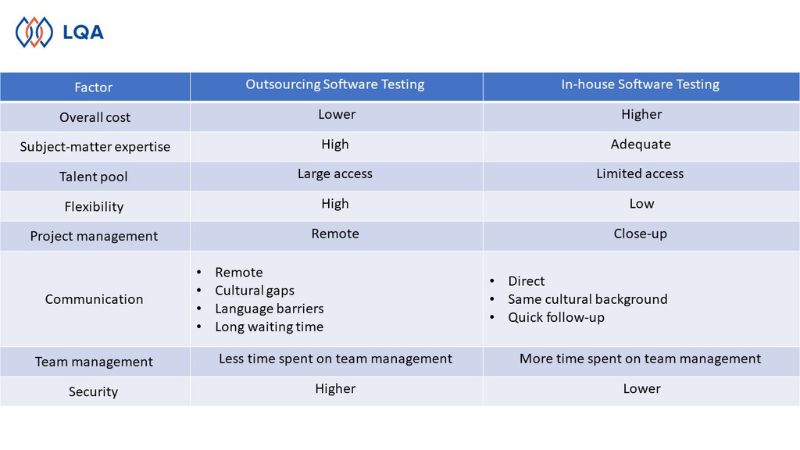
offshore and inhouse software testing comparison

Offshore and In-house software testing comparison


However, every coin has two sides, outsourcing software testing also has some drawbacks, including language barrier and low security. Therefore, businesses must survey, learn and thoroughly evaluate the reputation of vendors before cooperating. Deeply aware of these concerns of businesses, LQA has always focused on improving the English skills of its personnel and always puts security first. With a closed quality management process and absolute security, LQA has been trusted by many large enterprises such as LG Electronics, Toshiba, Qualacomm, FPT, Baoviet,…


8. How many Offshore Software Testing Models are there and Which one is the Best-fit?

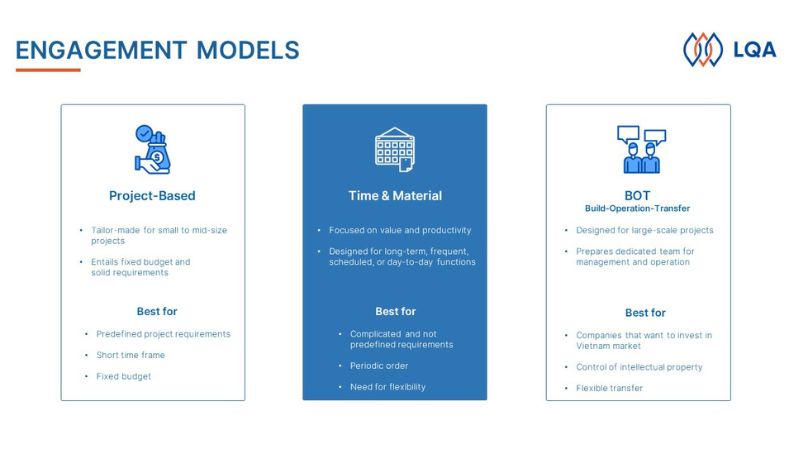
Once you have chosen a reputable vendor to outsource testing services, the next thing you need to pay special attention to is to agree on technical and engagement models from the very beginning. Working remotely with a team sitting on the other side of the globe will lead to miscommunication, misunderstandings in the process of cooperation. To limit this, businesses must agree on the process and way of working from the beginning. Below are the commonly used models and the cases where each specific model should be applied.
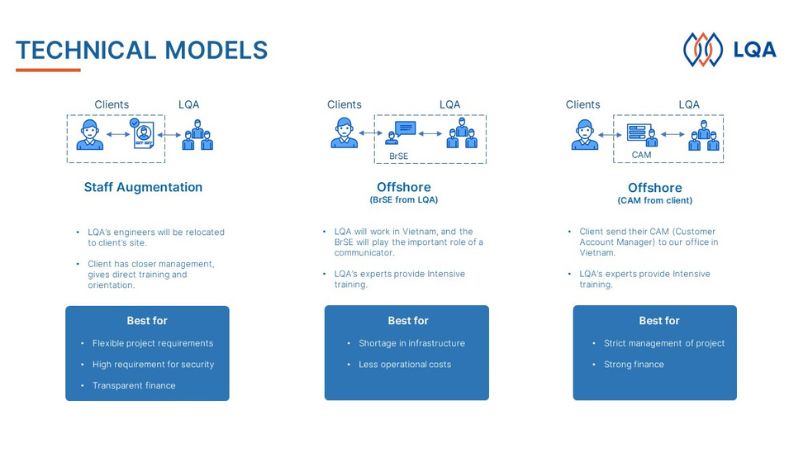
lqa software testing service technical model
LQA software testing service technical model

lqa software testing service engagement model

LQA software testing service engagement model


Final Thoughts

LQA has listed and answered the above questions based on previous experience working with businesses. The above 8 questions are the 8 problems that many businesses worry the most when learning about Software Testing solutions. With thorough answers, LQA hopes to help you understand more about this field and find the best solution to optimize your business’ QA process and speed up time to market. If you are still struggling and need further professional advice, the LQA experts can help!


We, at Lotus QA, are just a contact form away:

Website: lotus-qa.com/

Tel: (+84) 24-6660-7474
Fanpage: https://www.linkedin.com/company/lqa//

Blog

A Comparison of Manual Testing vs. Automation Testing


Hi there! Welcome to LQA’s guide on Manual Testing vs. Automation Testing comparison, their characteristics, applications, and when to use each method. 

We will cover manual testing and automation testing differences in an infographic. But before going into details, we want you to be clear that:

  • Manual testing is the traditional and fundamental test method in software testing. We often use the manual method to test new products or when we don’t have a clear understanding of the products or when the systems haven’t become stable yet. 
  • Automation testing is considered a high-tech test method in comparison to manual one. We often use this test method to reduce resources and time consumed for testing a system that is stably functioning and we already clearly know about it.

So, an ideal path is to use manual testing for the first time(s) and utilize automation testing to reduce test efforts and increase test productivity when things become stable and predictable!

Also, automation test doesn’t mean that the whole test process will be automated. Such steps like Requirements analysis, Test planning, and Test case design are done manually before a test automation engineer can program the test script and start automation test execution and test report.

That’s a quick look. And now, let’s go into comparison!


manual test vs. automation test comparison infographic

Manual Test vs. Automation Test Comparison


You may want to know: 6 steps to transition from manual testing to automation testing.

So, Manual Testing vs. Automation Testing – Which one is for you?

The answer of whether you should choose automation testing or manual testing depends on your situation. For example, choose manual test if:

  • Your product is new and you don’t have experience with this kind of product before.
  • The AUT (Application under test) changes frequently.
  • You have a limited budget.
  • You want to ensure user-friendliness in the product.
  • You want to handle complex test cases.
  • Your team doesn’t have the tech ability (for any reason) to set up and maintain automation.

And choose automation test if:

  • There are repetitive tasks in a stable-functioning system and you want to reduce these tasks.
  • When your system has frequent releases and you want to decrease test cycle time to speed up the processes.
  • You have a great budget for building automation testing. 
  • You consider the test ability is needed in a long-term period.
  • You want better transparency of testing activities. Statistics and graphs about the test process, performance, and error rates are explicitly indicated.

Want to dig deeper into manual testing vs. automation testing and decide the one suitable for your business? Contact LQA now for a FREE consultation with our specialists and experts.

Automated TestingAutomated TestingAutomated TestingAutomated TestingAutomated TestingAutomated TestingAutomated TestingAutomated TestingAutomated TestingEmbedded TestingEmbedded TestingEmbedded TestingEmbedded Testing

5 Lý Do Tại Sao Nên Thuê Ngoài Dịch Vụ Testing


Kiểm thử phần mềm là một quy trình quan trọng trong vòng đời phát triển phần mềm. Tuy nhiên, nhiều doanh nghiệp với sự hạn chế về nguồn lực cũng như chuyên môn và thời gian đã lựa chọn thuê ngoài dịch vụ testing như một giải pháp thay thế hữu hiệu cho nguồn lực nội bộ. 

Trong bài viết này, chúng ta sẽ tìm hiểu 5 lý do tại sao nên thuê ngoài dịch vụ testing nhằm giúp các doanh nghiệp có thêm thông tin trong việc lựa chọn giữa insourcing và outsourcing. 

1. Hiệu quả về chi phí 

Sử dụng dịch vụ testing thuê ngoài giúp doanh nghiệp giảm thiểu các chi phí về nhân sự, quản lý và cơ sở hạ tầng cho hoạt động kiểm thử phần mềm.  

Đầu tư nguồn nhân lực và cơ sở hạ tầng cho một quy trình kiểm thử phần mềm nội bộ luôn là một thách thức với các doanh nghiệp có nguồn lực hạn chế. Bằng việc sử dụng dịch vụ testing của công ty kiểm thử phần mềm, doanh nghiệp có thể tránh được một số vấn đề như sau: 

  • Sự thiếu hụt nguồn nhân lực testing trong bối cảnh cuộc chiến nhân tài công nghệ ngày càng gay gắt. 
  • Chi phí tuyển dụng và phúc lợi cho nhân viên trong ngành IT cao. 
  • ROI thấp do nhu cầu sử dụng thấp nhưng chi phí đầu tư cho cơ sở hạ tầng (phần mềm, thiết bị test) cao. 

2. Cải thiện chất lượng kiểm thử 

Thuê ngoài dịch vụ testing giúp doanh nghiệp tăng chất lượng kiểm thử nhờ nguồn nhân lực có chuyên môn cao, đa dạng phương pháp kiểm thử và tiếp cận nhiều luồng quan điểm khách quan hơn. 

Lợi ích về nguồn nhân lực 

Nguồn nhân lực testing tại các công ty chuyên về dịch vụ kiểm thử phần mềm thường được đào tạo bài bản và có nhiều kinh nghiệm trong ngành. Ngoài ra, các công ty dịch vụ chuyên nghiệp có khả năng thu hút được các chuyên gia trong ngành cao hơn. Do đó, thuê ngoài testing giúp doanh nghiệp ở mọi quy mô tiếp cận nguồn nhân lực chất lượng cao và thực hiện việc kiểm tra chính xác hơn. 

Đa dạng phương pháp kiểm thử 

Trong một số trường hợp, việc kết hợp các phương pháp kiểm thử khác nhau giúp gia tăng hiệu quả phát hiện lỗi và giảm chi phí kiểm thử phần mềm về lâu dài cho doanh nghiệp. Tuy nhiên, để đầu tư một đội ngũ kiểm thử nội bộ đa chuyên môn luôn là một thách thức. 

Ví dụ: Xu hướng kết hợp phương pháp Kiểm thử thủ công và Kiểm thử tự động trong một sản phẩm phần mềm đang trở nên phổ biến.   

  • Kiểm thử thủ công cho functional testing, compatibility testing. 
  • Kiểm thử tự động cho API testing và performance testing, cũng như các thao tác lặp đi lặp lại. 

Tuy nhiên, kiểm thử tự động yêu cầu người kiểm tra có khả năng về code và các công cụ phần mềm hỗ trợ như Selenium, Katalon và không phải nhân viên kiểm thử thủ công nào cũng có thể nhanh chóng chuyển qua kiểm thử tự động. Do vậy, việc thuê ngoài testing sẽ giúp doanh nghiệp liên tục cập nhật các công nghệ, phương pháp testing mới nhất, mang lại hiệu quả phát hiện lỗi và lợi ích về đường dài cao hơn. 

Tiếp cận nhiều luồng quan điểm 

Một nhóm kiểm thử nội bộ có thể có các thiên kiến hoặc những hiểu biết trước về sản phẩm và chỉ chăm chú vào các khía cạnh đó. Tuy nhiên, một nhóm kiểm thử bên ngoài không có kiến thức trước đó về sản phẩm sẽ chú ý đến mọi góc cạnh và có xu hướng đánh giá lỗi khách quan hơn, nhìn ra nhiều vấn đề hơn và thực hiện testing toàn diện hơn. 

3. Giảm thời gian đưa sản phẩm ra thị trường 

Một lợi ích khác của việc thuê ngoài testing là sự linh hoạt trong việc tăng/giảm quy mô nhóm để nhanh chóng đáp ứng với các biến số và tránh sự gián đoạn trong quá trình phát triển phần mềm.  

Ngoài ra, quy trình làm việc tối ưu cùng năng suất làm việc cao của công ty kiểm thử phần mềm cũng góp phần đẩy nhanh giai đoạn kiểm thử, giúp rút ngắn thời gian phát triển và đưa sản phẩm ra thị trường nhanh hơn.  

4. Giảm rủi ro mâu thuẫn nội bộ 

Thuê ngoài dịch vụ testing giúp doanh nghiệp giảm được rủi ro về mâu thuẫn giữa nhóm phát triển và nhóm kiểm thử trong một quy trình phát triển phần mềm.  

Trong khi các nhà phát triển muốn hoàn thành công việc trong thời gian ngắn nhất, các chuyên gia kiểm thử thường vô tình kéo dài thời gian phát triển với việc cố gắng tìm ra lỗi và yêu cầu sửa lỗi. Do đó, mâu thuẫn này luôn tồn tại trong các công ty công nghệ và việc thuê ngoài đội kiểm thử sẽ giảm thiểu tình trạng xung đột trong nội bộ công ty. 

5. Tập trung vào lĩnh vực cốt lõi 

Một lợi ích rõ ràng khác của việc thuê ngoài dịch vụ tesing là doanh nghiệp có thể tập trung nguồn lực vào các hoạt động quan trọng và mang lại hiệu quả sử dụng nguồn lực cao hơn. Ngoài ra, việc chuyển giao bớt công việc cho đối tác giúp giảm áp lực lên các nhân viên của công ty, giúp mọi người làm việc năng suất hơn và tạo nên môi trường làm việc hiệu quả hơn.  

Lựa chọn đối tác kiểm thử tin cậy với LQA 

Như vậy, có nhiều lợi ích để một công ty quyết định thuê ngoài dịch vụ testing. Nếu bạn đang tìm kiếm những yếu tố này thì kiểm thử phần mềm thuê ngoài rất đáng để cân nhắc: 

  • Tiết kiệm chi phí 
  • Cải thiện hiệu quả kiểm thử 
  • Hiệu quả về đường dài 
  • Giảm thời gian phát triển sản phẩm 
  • Giảm rủi ro mâu thuẫn nội bộ 
  • Tập trung vào lĩnh vực cốt lõi 

LQA là một công ty chuyên về dịch vụ kiểm thử và đảm bảo chất lượng phần mềm với 6 năm kinh nghiệm cung cấp giải pháp tùy chỉnh cho khách hàng đến từ 9 quốc gia. Liên hệ LQA ngay để được tư vấn về dịch vụ kiểm thử phần mềm cũng như các kiến thức liên quan!   


How to Ensure Quality in Software Development Outsourcing

The matter of how to ensure quality in software development outsourcing is one of the most important features that project managers need to address. As you work with an external party in software development outsourcing, you lose complete control over your project. In this case, several measures need to be taken into consideration to ensure the quality of the said project.

From a service provider’s perspective, Lotus Group has its own way of ensuring quality, which you might find useful in your project.

1. Have control over our human resources

Software development outsourcing, or IT outsourcing in general, is an emerging service as the world is shifting towards digital transformation. In this new field, the most famous service providers are those from the less-developed countries which have lower labor costs. 

However, soon their sources of IT workers become limited, as it is getting harder and harder to hire competent tech staff. To deal with this universal problem, Lotus Group plans to change our stance in the hiring markets. Instead of recruitment only, we want to be more proactive in providing IT talents to our clients. To do this, we have founded Lotus Academy – a training institution specializing in backend and frontend technologies for freshers/newbies in the IT industry. 

With the foundation of Lotus Academy, Lotus now can take advantage of the resourceful talent pool, hence providing the most competent and reasonably-priced tech staff. 

Technology training is in high demand, and the number of students in Lotus Academy will only rise in the future. And with the high number of students rolling in, Lotus can train them and let them take part in our projects. With careful observation and guidance from our experienced trainers, your project will be well-tended with care.

Besides the source from Lotus Academy, Lotus Group also has our connection with many other universities and colleges in Vietnam. These training institutions have a thorough training course with actual projects for the students to practice, which can be of great benefit for you.

2. Implement manual and automation test early

Technically speaking, the quality of one product/project relies on how you implement the testing process. If you follow the method of waterfall or even V-model, you leave the testing till the last minute, making the time-to-market longer than ever.

Instead of developing and testing at different times, you should combine regular testing and structured QA strategy in your software development life cycle to make sure that everything will be tested and fixed quickly.

In your testing process, manual testing and automation testing should be combined to catch the bugs that thinner testing strategies may have missed.

According to a study by Capers Jones, 85% of the bugs are made during the design and build stages of an SDLC, and some are even there before the first line of code is written.

By implementing manual and automation test early, you can work on how to fix these bugs before they can make their way to your releases, which will in turn ensure software quality and save you a lot of time.

3. Have clear communication methods and channels 

The first and most important question that every manager has about remote work communication best practices is about management. Management used to entail task allocation, monitoring, and administration, among other things. Managers can easily track cues to indicate communication issues and get involved in fixing them with a co-located team. A remote team, on the other hand, works off the screen, posing difficulties for managers.

Managers used to have physical and emotional contact with their employees, but now have little to no direct interaction with them. Managers are required to implement some of the tools and approaches to achieve remote work communication best practices from a place of easy-to-manage work platforms such as Skype or Excel spreadsheets.

For seamless communication, you have to set out clear communication methods and channels. How should reports be handled, how often should you call in for a meeting? These are the kinds of questions that you need to answer when you want to tackle the communication aspects of a software outsourcing project.

4. Use agile methodology (incremental and iterative)

Agile methodology has always been praised as one of the most effective software development methods there are in the field. Indeed, in agile project management, everything moves at a high speed, and testing is an integrated part of the project execution phase. 

This means that instead of processing the quality of different features separately, agile works with the overall quality of the final product. 

In Agile methodology, you will always be involved in the development process and can easily make changes if you wish to. To put in other words, Agile allows a greater level of flexibility which many businesses now want for their projects.

In addition, agile is an iterative process, and the team will inevitably have to learn to grow and improve their work overtime. And this can be of great advantage for you to ensure the highest quality on your project.

All of the above is what Lotus Group is applying to ensure a high-quality project for our clients. Besides all these, we also have other methods for different kinds of service. If you want to hear more about this, contact us:

IT OutsourcingNews

Top Countries for Software Quality Assurance Services

A successful software QA outsourcing project requires not only a thorough understanding of your objectives but also in-depth knowledge of the testing market around the world. In this article, let’s find out more about the top countries for software quality assurance services to choose the most suitable destination for your outsourced test center.


A Quick Review of Top Countries for Software quality assurance services

To make a favorable destination for outsourcing software quality assurance services, it takes the compilation of many features, including the average salary, Education in IT, Policies for foreign clients, the current number of QA engineers and technical skills. Take a look at this simplified table to gain an overview of the countries with the top software quality assurance services.


Average yearly salary Number of annual IT graduates Focused segments of

software testing

India $4,334 1,500,000 (engineering and technology) AI for automation

Automation testing

End-to-end testing

Cloud Testing

Vietnam $7,631 50,000 Application testing

Automation testing

Manual testing

API testing

Full Cycle testing

The U.S. $75,242 2,170,000 Application testing

Cloud testing

IoT testing

Security testing

DevOps testing

AI testing

Ukraine $8,000 130,000 Full Cycle testing

API testing

Agile testing

Automation testing

Game testing

Poland $17,148 98,250 Manual Test Design and

Execution

Automated Testing

Test Automation Framework Design

Functional Testing

Load & Performance Testing

End-to-End Software Testing

API Testing

The Philippines $8,724 171,960 Application testing

Automation testing

Manual testing


1. India

Currently, India reigns as the most renowned destination for software testing outsourcing in particular. The deciding factor making India the top software quality assurance services country is the reasonable costs for hiring a software tester. With a large pool of low-cost software test engineers, India offers the lowest price for testing services.

In terms of technology, test engineers from India tend to go for the latest and upcoming technical features. In fact, TopCoder has rated India as the 10th most advanced country in terms of Programming skill rankings across the popular outsourcing locations.


Software quality assurance services in India

Software quality assurance services in India

According to research from Deloitte, in terms of governmental policies, India also favors foreign investors, especially in the technology sector. Moreover, the longtime experience in delivering IT services and the undeniable reputation of India in the global IT market have led the government to offer incentives in the best way they can. Besides the policies for the growth of technology in general, India has always boosted education in technology with multiple incentives and many more technology institutions. Such supports from the government has granted India the opportunity to thrive with the largest talent pool.

Also read: Essential QA Metrics to Navigate Software Success

2. Vietnam

Vietnam is the “rising star” in the global software quality assurance services market. Although Vietnam has only gained its reputation recently, the country turns out to be a small but vibrant destination for top-quality software testing services. Every year, there are about 50,000 tech junior graduates from technology institutes, providing an abundant source for Vietnam’s talent pool. About 20% of these graduates will work in the software testing industry.


Software quality assurance services in Vietnam

Software quality assurance services in Vietnam


What’s so special about the testing services from Vietnamese vendors is the high-quality human resources. According to the A.T. Kearney GSLI, from the early education on Information Technology to the resource availability and financial attractiveness, Vietnam always works towards to best quality in our IT workforce. In this chart, Vietnam ranks alongside India and The Philippines – two popular IT Outsourcing countries. Plus, Tholons Global Innovation COUNTRY INDEX – 2020 ranked Vietnam in the 9th place for talent, skill and quality, proving the country’s capability to ensure high-quality testing services and catch up with the latest testing trends.

The workforce for software testing in Vietnam is well-trained of the required skills in QA processes. For example, the automation testers in Vietnam will sure know the automation tools and frameworks such as Selenium, Appium, Cypress, Ranorex, Eggplant, Katalon, etc.

In terms of government policies, there have been some decisions and laws to protect intellectual property development and cybersecurity, all of which are of great benefit to businesses planning to outsource their software quality assurance services in Vietnam.

Read more: Why you should choose Vietnam as your IT Outsourcing destination


3. The U.S.

Despite the rising positions of many other test hubs in the world, the U.S. remains a trustworthy destination for outsourcing testing services. Among tech nations, the U.S. has always been one of the leading places for the most ground-breaking technologies. The application of the latest technologies in the U.S. is the most advanced. Unconsciously, the work quality in the U.S is the standard for every other country to follow as this country has a high level of professionalism.

Software quality assurance services in the US

Software quality assurance services in the US


When working with software testing vendors from the U.S., the obvious benefit for you is the language. Since the U.S. has a wide variety of cultures, it is very easy for you to get people with the same cultural background as yours.

Also, America is the home to many famous software testing outsourcing companies in the world, namely Mindful QA, ScienceSoft, QA Mentor, etc. These companies have already made their names in the global testing market, and are trusted destinations for business from all around the world.


4. Ukraine

Information Technology is one of the key strategic industries in Ukraine. The value of Ukrainian software outsourcing exceeded $5B in 2020. Also, Ukraine was named the “Offshoring Destination of the Year” by Global Sourcing Association (GSA) in 2017 and ranks 20th the GSLI.


Software quality assurance services in Ukraine

Software quality assurance services in Ukraine

According to a popular vendor in Ukraine, the country has more than 1,600 IT service providers, and about 90% of them offer testing services. What’s more, 24% of IT specialists in Ukraine are QA/testers, and 19% of them have 7+ years of experience. There are a little over 48,000 QA experts, and around 16,000 ICT graduates enter the market annually.

The country organizes a wide range of QA conferences such as BAQ Conference, QA Fest, Security Testing Marathon, IT Weekend Lviv: Software Testing & Big Data, etc.


5. Poland

The country’s IT services market reached $4.6B in 2019. Around 32% of Polish IT experts work for IT outsourcing (others are working for BPO and GBS companies). Around 29,000 QA professionals are involved in the IT sector in Poland. There are also 500+ IT companies that offer outsourced software testing services.


Software quality assurance services in Poland

Software quality assurance services in Poland


Moreover, Poland was ranked 15th in Tholons’ Top 100 Outsourcing Destinations. Poland was also listed 16th in the world for English skills in the EF English Proficiency Index.


6. The Philippines

The Philippines is one of the biggest names for IT Outsourcing and software quality assurance services in Southeast Asia. The BPO and outsourcing industry, in general, has been in The Philippines since the mid-1990s, making this country a favorable and professional environment for IT outsourcing operations.


Software quality assurance services in the Philippines

Software quality assurance services in the Philippines


Besides the fairly reasonable price for the high-quality work, The Philippines can also provide you with the following:

  • Effective communication as English is one of the national languages in the country. Almost every tech engineer in The Philippines can speak fluent English. This also leads to cultural fit and compatibility with western countries, bridging the gap in the communication process.
  • Famous IT Outsourcing destination with favorable investment policies. Since The Philippines has been in the market longer than any Southeast Asia country, it has long developed a friendly environment for foreign companies to cooperate with domestic IT service providers.
  • At present, Outsourcing companies in the Philippines employ more than 2 million people. Therefore, you will have access to a very large talent pool.


vietnam-software-outsourcing-contact-us-1


Consult IT outsourcing Strategy with Lotus QA

Lotus QA has the expertise and experience with testing services in many domains such as retail, food and beverage, healthcare, etc., making us one trustworthy and professional service provider for businesses wanting to implement testing. When working with us, you will get access to:

  • High Security: LQA not only follows stringent procedures of ISO 27000:01 for optimal security and international standardized process but also flexibly adapts to clients’ requirements
  • Quality Human Resource: we ensure staff competency through strict rounds of interviews, on-job orientations, continuous learning & development for the most suitable QA staff.
  • Flexibility: We provide different working models to allow clients to choose or change the plan at any time.

Contact us for more support with testing services:

Automated TestingEmbedded Testing

Top 10 Software Testing Companies in Vietnam 2023

With the increasingly high demand for software testing on the global market, Vietnam, as one of the top countries to provide software outsourcing services, has seen a rise in the companies offering software testing services. Software testing companies in Vietnam have many years of experience in quality assurance. These companies are the representatives of what Vietnam can offer for the testing market: affordable budget, domain experts and dedicated supports.

Top 10 software testing outsourcing companies in Vietnam

Lotus Quality Assurance

Lotus Quality Assurance (LQA) is ranking as top 3 Software testing companies in Vietnam, recognized by the Clutch B2B rating platform in 2021. Founded in 2016, Lotus QA is a young yet promising company working in the software testing industry. With a competitive price of no more than $25/hour, Lotus QA has successfully proven its competency and dedication to clients’ experience, gaining us the honorable Sao Khue awards and the reputation of top-notch services in the demanding market of America, Japan, Korea, etc.

Software testing services at LQA include QA consultation, testing implementation, and testing talents for hire. LQA’s expertise is mobile app testing, web app testing and automation testing, proven through successful projects with many renowned businesses in the world such as Toshiba, LG’s Electronics, AVN, Panasonic, etc.

Throughout 5 years of development, Lotus QA has witnessed the biggest growth rate in company size with 248 employees, 30% of which are manual testers and automation testers. With the experience working mainly in medium-sized and small projects, Lotus QA can well provide you with top-notch software testing services with midmarket and small businesses.

Lotus QA - Top Software testing companies in Vietnam

Lotus Quality Assurance (LQA) – Top Software testing companies in Vietnam

KMS Solutions, Inc.

With 12 years working in the IT sector, KMS Solutions have served 130+ clients, helping them save $139M in different IT services, notably software testing services.

To achieve these impressive numbers, KMS Solutions provide industry-leading solutions for sustainable, profitable growth. Through comprehensive software QA and testing services, KMS Solutions offer high-quality engineers with comprehensive domain experience, with a competitive price.

Especially, KMS Solutions apply an automation-first mindset to everything they build. This mindset allows their testers to deliver quality software at faster speeds expediting your time-to-market.

FPT Software

FPT Software is a giant in Vietnam’s IT outsourcing market with an international-acclaimed reputation. In FPT Software, clients work with a Testing Center of Excellence (TCoE), which is a command center that makes use of standardized tools and processes to enhance the alignment between enterprise environment and IT, and increase QA efficiency.

FPT Software can provide you with multiple quality assurance and software testing services, but the most recent success of FPT Software lies in the implementation of automation testing. With the use of certified and standardized testing tools, FPT Software gains the trust of many clients. To meet the requirements of testers, FPT Software has developed a team of 1,700 testers worldwide, offering their expertise to 200+ clients of all industries.

Logi Gear

Established in 1994, LogiGear is always rank in Top Software testing companies in Vietnam with wide experience, especially in automated testing. They spent more than 27 years optimizing their testing services. The most stand-out testing services in Logi Gear are:

– Automation testing: With well-versed experts in a variety of Test Automation tools, Logi Gear can boost up the testing process and save time.

– Functional testing: LogiGear provides a QA functional testing service that utilizes decades of knowledge of Software Testing and specialized Test Automation tools.

– Offshore teams: LogiGear can solve the problems of lack of Subject Matter Expertise, lack of Infrastructure/Resources, scalability of QA and time-to-market.

CO-WELL Asia

CO-WELL Asia is currently an emerging destination for software testing services. With 400 IT engineers working in Hanoi and Da Nang that graduated from the top universities of Vietnam and many others all over the world, CO-WELL Asia can offer a higher ratio of QA testers to programmers in comparison to other Vietnamese companies.

Especially in CO-WELL Asia, various training courses have been organized in Vietnam as well as abroad to enhance staff’s technical level and soft skills. With these skills, CO-WELL Asia can bring optimum value to our customers.

In terms of skill composition, 40% of the staff are PHP, 12% of .Net, 12% of Java, 36% of HTML, iOS, Perl and other languages. Moreover, CO-WELL Asia achieved ISO/IEC 27001:2013 Certificate of Information Security Standard and multiple Sao Khue awards, including the best ten software outsourcing services in Vietnam.

MeU Solutions INC

For MeU Solutions, their main testing services are Manual Testing, Automation Testing and Security Testing. Through their 13 years of experience, they have done 100+ projects with 30+ pools of real devices. Their current testing staff is 30+ QA engineers, working with a low hourly rate of under $25/ hr.

With profound expertise in testing an extensive range of iOS, Android and web applications, MeU Solutions INC has successfully delivered quality apps to global clientele.

TMA Solutions

TMA Solutions was established in 1997 to provide quality software outsourcing services to leading companies worldwide TMA Solutions is one of the largest software outsourcing companies in Vietnam with 3,000 engineers. Their engineering team was selected from a large pool of Vietnam IT engineers; they are well-trained and have successfully completed many large and complex projects.

TMS Solutions is quite a big name in the Software Testing market in Vietnam. Their main service offerings include full product verification, test planning & execution and test automation. With just under the fee of $20/ hr, you can hire their best teams to carry out software testing services for you.

SHIFT ASIA

SHIFT ASIA opened its office in HCM Vietnam in 2016, as a strategic SEA hub to scale operations and better serve the greater APAC region. Started off with 25 QA professionals for the manual testing division, SHIFT ASIA has since grown into a full-functioning office handling international clients.

Through their years of development, SHIFT ASIA now has 200 passionate employees with diverse backgrounds and expertise. The things that facilitate our wide service offerings are security assessment, test automation, international inspection, offshore development and many more.

Waverley Software

Waverley Software is another big name in the list of software testing companies in Vietnam. This brand was started in 1992 in the US, and then reached out to the world through the expansion in many countries, namely Vietnam.

In Vietnam’s market, Waverly Software stands out as a top-quality QA company, providing all kinds of testing services. Waverley’s quality assurance and software testing services help companies around the world build

uality products. They conduct QA audits, provide standalone software QA, manual testing, and test automation services using agile testing methodology. At Waverley, they design their own testing tools; provide various types of software testing; write test documentation including test plans, checklists and test cases; monitor quality metrics and conduct data analytics. Their office in Ho Chi Minh City hosts some of South East Asia’s top software testers. Waverley Software conducts training programs for technology graduates on a regular basis, which allows them to rapidly scale their clients’ teams with trained talents for a smooth testing process.

Axon Active

Axon Active is the last name in the top 10 software testing companies in Vietnam. Axon Active’s offshore testing center not only provides regular offshore software testing services but also works towards becoming a trusted consulting partner. They aims to help design a strategic software testing process for the clients’ business and advice suitable software testing solutions that improve your business efficiency and performance, helping you achieve long-term objectives.

A quick comparison among the top 10 software testing companies in Vietnam

Company Hourly rate Employees Founded Year Main testing services
Lotus Quality Assurance < $25 / hr 248 2016 – Web & Moblie App Testing testing

– Embbeded Software Testing

– Automation Testing

– Integration Testing

– API Testing

KMS Solutions, Inc. Undisclosed 50 – 249 2009 – Test Automation

– API Testing

– Mobile Testing

FPT Software < $25 / hr 10,000+ 1988 – Web & Moblie App Testing testing

– Embedded product testing

– Cloud testing

– Inter-operability (IoP) testing

CO-WELL ASIA 1,000 – 9,999 $50,000+ 2011 – Web App Testing

– Mobile App Testing

– Data Migration Testing

– Testing tools & Project management tools

Logi gear Undisclosed 50 – 249 1994 – Web & Mobile Testing

– Test Automation

– API Testing

– Localization Testing

– Games & IoT Testing

MeU Solutions INC < $25 / hr 50 – 249 2016 – Shift-Right Testing

– Effectively Managed Testing

– Automation Sign-On Package

TMA Solution < $25 / hr 1,000 – 9,999 1997 – Full Product Verification

– Web & Mobile App Testing

– Test Automation

SHIFT ASIA < $25 / hr 50 – 249 2016 – Web & Mobile App Testing

– Vulnerability Test

Axon Active Undisclosed 250 – 999 2008 – Web & Mobile App Testing
Waverley Software $25 – $49 / hr 250 – 999 1992 – Web & Mobile App Testing

Conclusion

Vietnam has the potential to become a new software testing outsourcing hub of Asia. With the Introduction of top 10 Software Testing Company in Vietnam, we hope you can find the best service provider for your testing projects. If you are small or medium-sized company looking for top-notch software testing companies in Vietnam, you can contact Lotus Quality Assurance’s expert and let us know what we can help you with!

What aspects need to know about interview software tester

As software testing is a compulsory procedure in any software development life cycle to ensure product quality, any tech company would need a team of testers to devise and execute tests.

As opposed to the increasing number of software developers available on the market, that of software testers is not abundant. In fact, it has been reported that there would be an alarming shortage of software testers as growing demand outstrips the number of graduates entering a profession that many reject as unglamorous.

Interview Software Tester - Essential checklist

Interview Software Tester – Essential checklist


Although the seemingly attractive offer of high salary is put on the table, it is still very difficult to find an experienced software testers. Hence, many businesses have to resort to the junior testers, hoping them could learn their way to more skills and knowledge.

With this resourceful yet inexperienced talent pool, businesses are compelled to preparing a thorough and complete checklist of what they have to know about there candidates for the job of software testers. The technical aspects that should be put into consideration are:

  • Basic knowledge for testing types and how to approach testing
  • Test environment
  • Test domains, domain-specific knowledge & candidates’ experiences
  • Test tools (for both technologies and management)
  • Test process and how to adapt to that process

What interviewer should clarify about your software tester interview process

– Clarify what kind of testing engineers you are looking for. When it comes to testing, the two most popular jobs are manual testing and automation testing. For each of these approaches, there are different criteria for you to consider when interviewing.

– What domain(s) you are aiming at. If your business is fixed within a particular industry/service, this clarification won’t be too complicated. Nevertheless, in the case of IT Outsourcing vendors recruiting for their talent pool, the recruiter should clear out what domain(s) for their next project to find the best-suited candidates.

– The career path for engineer testers when they’re onboard. Many test engineer want to build their way up in their career path, and this is what they expect to get from their employer. Make sure that the interviewer and the interviewee stay on the same page in regards to career path to avoid any conflict in the future.
Technical aspects to interview software testers

Talent gap is not incommon, but it doesn’t mean you would have to hire any testers there are on the market. With careful consideration over what you want in your testers, finding the suitable candidates is not entirely an tough challenge.

1. Basic knowledge for testing types and how to approach testing

For every tester, it is a must for the candidates to cover the basic and fundamentals of what test types they are going to work with. If they fail to tell the differences of, let’s say, GUI testing and API testing, it can be a big disadvantage. The lack of basic knowledge can result in numerous hiccups during your work, not to mention the time wasted on training for this elementaries.

Hence, for this part, the interview questions should be devised to sort out the ones that did their research and those didn’t bother to learn.

Interview Software Tester - Testing types

Interview Software Tester – Testing types


Please do remember that any of the questions concerning testing types and the differences among them can be easily found and answered online with details. The interviewer should not identify these as the deciding factor for the interview results. Instead, this should be the defining factor of how good they are with theoretical knowledge.

Between manual testing and automation testing, the interviewer should ask somes questions with regards to their differences.

For example, you can ask what test types are suitable for automation testing and what test types can’t be executed with automation testing. These question help indicate the overall knowledge of testing that the candidates have, helping interview forming the initial perspective about them.

2. Test environment

To put it simple, a test environment is a setup of network, software and hardware for test executions. Also known as test bed, test environment is configured based on the Application Under Test.

interview-software-tester-test-environment

Interview Software Tester – Test Environment


When interview want to dig deeper into how candidates work in their testing projects, there should be specific questions about the test environments. Through these questions, you can know:

  • How does the candidate devise test environment? Is the process thorough enough or similar to that of your system?
  • How does the candidate organize multiple environments for testing?
  • What checklist of test environment elements that testers have to cover in their testing process?

3. Test domains, domain-specific knowledge & candidates’ experiences

As digital transformation is present in every aspect of out lives, so does software testing. However, among the applied domains, the most popular are finance & banking, healthcare, argriculture, entertainment, etc.

For each specific domain, there will be different software structures, hence the different approaches for software testing process.

Interview Software Tester - Test domains

Interview Software Tester – Test domains


For example, in the finance and banking system, the interviewer are likely to ask test candidates about the security testing process.

The reason for this is that for financial institution and organizations, data security tops of priority. Personal information and financial status stand as the most at-risk kind of information in the world. Working as a tester in this sector, the candidate is required to ensure each transaction be secure and accurate. For businesses working in finance and banking, the questions about how they carry our security testing are definitely on the list.

4. Which test tools (for both technologies and management)

When talking about test tools, we want to refer to both techical and managerial tools.

First, about management tools, it is recommended that the interviewer ask about the most frequently used tools and how the candidates can cooperate on that platform. The act of bug and work reporting should be also included in this part.

About technical testing tools, it should be divided into 7 main types of testing tools, including:

  • Test detecting tool
  • Mobile app testing tool
  • Cross-browser testing tool
  • Automated testing tool
  • Load testing tool
  • API testing tool
  • Security testing tool

It is impossible for one for master all of the kinds of testing tool above. To know whether the candidate are suitable for your testing team, the interviewer should ask specifically about the testing tools that your team are gonna use the future.

5. Test process and how to adapt to that process

The testing process indicates how the whole testing team deal with one particular project. Normally, a testing process includes the following steps:

  • Planning and Control
  • Analysis and Design
  • Implementation and Execution
  • Evaluating exit criteria and Reporting
  • Test Closure activities

Interview Software Tester - Testing process

Interview Software Tester – Testing process


These steps can be changed upon requests of clients with customization. ISTQB, which is a prestigious institution of testing and quality assurance has pressed the international standardized process for companies to follow. However, customization is also very common.

Walking through every step of the process, testing is executed with thorough analysis and close supervision. In these steps, it is vital to involve Business Analysis, Testers, Developers and QA staff to ensure a stringent and high-quality process.

With the 5 above aspects to get to know about your test candidates, through which you can devise a checklist of what you would want from them, we hope you can find your best-suited test engineers.

If you don’t know where to start with tester recruitment process, contact us for expert consulting at:

Ultimate Guide for Managing IT Outsourcing Projects

IT Outsourcing is the way to go for many projects and many companies worldwide. As the information technology industry progresses and thrives, the fostering of digital transformation is on the rise, even for companies that have no strategic core of technology development. 

Whether it is an enterprise or a startup, IT Outsourcing can be the tactical approach for prospects and enhancement, not to mention the cost-barrier to be lowered when implementing this.

However, as if managing complex technology projects wasn’t difficult enough, IT outsourcing can be a loose screw in your overall IT operations if the management methods go off the rails.

In fact, it can create numerous stresses that you have never experienced, causing malfunctions and underperformance when using an external team.

Interesting enough, it is normally the lack of communication, strategic analysis and management skills that derail the project, not the technical competence of the IT Outsourcing providers. Indeed, the most important and primary aspect in managing outsourced projects lies within how to meld diverse organizations into a cohesive unit. To do this, you might want to follow these 9 strategic guides for a cost-effective and cohesive operation when working with IT Outsourcing companies.


Identify what to outsource

The picture of outsourcing is not as simple as you might think. In fact, the adoption and implementation of hiring someone outside of your organization require a thorough examination and assessment of what to outsource to ensure minimal cost and strict security.

What should always be kept in your mind is the ultimate goal of outsourcing, which is the cost to be reduced. The question here is, which operations and systems can be outsourced without damaging the business’s operations and core strategic services.

Identify what to Outsource

Identify what to Outsource


To do this, you should divide your operation into 2, one of which is a commodity system and the other is a strategic system. By stating the “commodity”, we meant the activities that keep you running but do not necessarily differentiate you from other competitors in the market.

By dividing your business activities accordingly, you can have a clearer look at which activities can be outsourced to a supplier with a reasonable price and which cannot be entrusted to outsiders. 


Choose your supplier

One special feature of IT outsourcing is the length of the contract. Normally, the outsourcing contract in other sectors could last for years, while in the IT industry, the average contract duration is 2 years. 

The reason for such a short contract time is the unprecedented and unpredictable changes in the industry, not to mention the ever-growing amount of new approaches and technologies. Many companies might want to change the terms and requirements in the contract to adapt to new features of the industry, and this is inevitable.

When choosing your supplier, another thing to take into serious consideration is to minimize the power of suppliers by soliciting separate bids for each service. By doing this, you have already minimized the risks of complete dependence on the suppliers.

On the other hand, one should not automatically assume that a supplier would outperform their own IT department. Instead, the in-house department should be allowed to compete with the outsourcing team to institute the best practices.

To constructively choose the right IT Outsourcing supplier, your business should form a team consisting of mostly IT professionals to review the proposed bidding for each contract. Their deep technical expertise, together with a clear understanding of the company’s goal, can keep an objective eye on the service, benefiting the business operations.


Clarify your business goals

The clarification of your core value proposition and business goals does not necessarily stay at the top of your priority list, but it is a must for smoother and more effective collaboration between you and your outsourcer.

This does not entail endless and lengthy training sessions and documentation exchange. In fact, the essence of this is to share your most important features and elements of your business such as business process, business model and your people. 

Clarify your business goals

Clarify your business goals


Once your business goals have been clarified to the outsourcer, they will have more information to adapt and align their approach in accordance with your business goals. To achieve this, a mutual understanding between two parties can help a great deal to create more value, both for your business and the outsourcing company.

For the case of IT Outsourcing, you need paramount consideration of how to define your business and software concept. The questions of what it can do, what target audience and how efficient you want it to be have to be answered right at the beginning of the project. Being on the same page about mutual interests and values can create a strong partnership, which can be of great use in the time coming. 


Make sure everyone’s working from the same playbook

Being cognitive is very much advantageous to your business when you want to adopt IT Outsourcing, but it does not simply mean the alignment in business values, business goals or anything so large-scale like that.

In fact, it is about the resonation in how to work, process, test and deliver. One way to ensure the well-designed and robust workflow of the two parties is to create a playbook that contains step-by-step instructions.

This method has long been in use in some giants of the IT industry when outsourcing. With a detailed hand-book, all information compiled can facilitate consistent application of your requirements. 

With this hand-book, the majority of information is the background and the technical material that could help them in further streamlining and managing the project.

During your work of outsourcing your projects, you might encounter IT Outsourcing companies from different parts of the world, and they might not be speaking English. 

Hence, besides the written documentation and requirements, preparing wireframes, annotated diagrams and other visual aids is also recommended. With your needs clearly conveyed through specific notes, the outsourcer has a higher chance of getting what you want.


Work effectively with the time-zone

Assuming that you’re working with an offshore IT Outsourcing service provider from Vietnam, while you’re in America. In this case, working in different time zones can cause much delay and inconvenience. To deal with this, you should be cognizant with the time difference, hence scheduling meetings that suit both parties.

Pay attention to the time zone

Pay attention to the time zone


By doing this, it not only helps you save time, it also shows your concern about your partner, through which you can build a level of trust and motivation for both parties to work harder. 

To make this work, you can take the following as an example. If you have partnered with an IT Outsourcing company in Vietnam, which is 11 hours ahead of the East Coast of the United States, you can send them something at the end of your business day, they can work on it while you are sleeping and have it back to you at the start of the next business day.


Build business communication

“Communication is the key.” With communication, a mutual understanding is formed with bells and whistles of the dos and don’ts in the projects.

Alongside the overall message to be delivered during the project, you also have to ensure the understanding over the project and the work required from every team member. 

You have to make sure that every team member has a clearly defined workload for the day, and understands their purpose of the project. Here’s how to do this:

  • Daily calls with the team or at least 2-3 times per week. 
  • Have a team of business analysts (BA) or a project manager (PM) to ensure that every stage of the software development goes smoothly. 
  • Regular but short meetings which prevent exhaustion with long discussions and get regular updates.
  • Involve a tracking mechanism (aka metrics) for measuring the team’s productivity and quality.


Use project management software

On a small scale, management software may not be the most necessary. In contrast, a large-scale operation would benefit your business the most if you use a collaborative platform to manage projects. 

In this platform, instead of staff keeping track of their own workflow, tasks and schedule in an unorganized manner, they can follow their work, time management, and task progress, in tune with their visualize colleagues

Use management software


In other words, this platform is like a gathering place which keeps all the records of one’s work, allowing users to accomplish more without getting distracted. 

When choosing a platform for your project, you should pay attention to the built-in extension and other broadening functionalities to find the most suitable one. 

For projects with sensitive security terms, some might find a customized or in-house built tool is more suitable. 


Adopt software development methodologies

There are many software development methodologies that you can make use of, the most famous of which is the Agile and Scrum method. These allow the outsourcing team to work under unification and collaboration. The feature of continuous integration and continuous delivery helps boost the speed of projects’ time to market. 

These also ensure flexibility, constant reiterations and close supervision upon the outsourcing team, entailing full control over the operation and activities.   


Sync up regularly

To effectively speed up and ensure the work of outsourcing, agreement on the sync-up schedule and reports should be made.

It can be done on a regular daily basis, or even weekly to ensure the time frame and outcome, especially if your outsourced team is in another time zone.”

“Effective communication, especially with new or off-site employees, is key to creating a more efficient, productive and profitable project,” says Handy. “Whether you are using Google Chat or Slack, keeping all project communication in one central location will increase accountability and allow all team members to communicate in real time.”

Operating an IT Outsourcing project in tune with your business culture that can ensure efficiency and productivity is tricky. With strategic approaches and detailed checklists of the dos and don’ts, you can easily lower the cost-barrier with IT Outsourcing providers. 


Don’t want to bother yourself with the trivial problems of IT Outsourcing? Contact LQA now for standard and scrupulous IT Outsourcing services.

Top 10 Trusted Automation Testing Tools for Your Business


With the widespread adoption of Automation Testing, businesses are now spoilt for choices of Automation Testing Tools. 

A plethora of automation tools, both open-source and vendor-source – have granted the market the opportunity to explore and deploy the best-suited ones for their firms. 

You must have gotten acquainted with the theory of how to choose the right automation, but turning this into practice is another story. As listed below are the top 10 trusted and curated automation testing tools with high credibility, divided into 3 categories of web app, mobile app and desktop app.


What testers need to know about testing: Principles, Skills & Testing phase

Enhance your software testing capabilities with global quality standards


Automation Testing Tools for Web App

Web App testing takes up a high percentage of the Quality Assurance market, hence the diverse and varied automation testing tools. These tools, in this case, should be feature-rich and support cross-browser compatibility.


1. Selenium

Selenium is among the most popular and renowned automation testing tools as the flagship automating web application for testing purposes.


“It is considered the industry standard for user interface automation testing of Web applications. Specifically, 54% percent of respondents used Selenium as their automation testing tool, according to the Test Automation Landscape in 2020 Report.” – Brian Anderson (Automation advocate & Selenium committer)


With the assistance of Selenium, the automation testing process can be implemented across different operating systems and different browsers, thanks to its two main projects.

With the 3 main projects of Selenium WebDriver, Selenium IDE and Selenium Grid, this tool empowers testers to automate browsers in a robust and versatile manner.

With the utility of diverse programming languages of Java, C#, Python, Ruby, PHP, Perl and JavaScript, etc., Selenium supports browser-based regression testing scripts and suites across multiple environments.

The extension for Chromium browsers and Firefox add-on also assists testers in writing quick bug reproduction scripts in automation-aided exploratory testing. This exploits the record-and-playback principle for automation testing implementation.


2. TestComplete

TestComplete from SmartBear offers a platform of multiple modules including Web app, mobile app and desktop app. Among these three modules, the outstanding one is the web application with the utility of reusable tests for all web applications. 

TestComplete Automation Testing Tool

TestComplete Automation Testing Tool

With the record & playback test approach, testers can use modern programming languages like JavaScript, Python and VBScript, etc.

TestComplete majors in GUI test automation tool with the assistance of AI and ML, empowering object recognition engine and script/scriptless flexibility. CI/CD is implemented for the increase in speed of delivery.

The TestComplete tool gives you access to 2050+ on-cloud test environments, making it easier for real device maintenance, virtual machines and in-house testing labs.

Accompanied by these on-cloud testing environments is the utility of manual testing which can be applied in any phase for better test coverage and accuracy.


3. Katalon

Katalon is another automated UI testing tool with convenient access to any type of testers, including the ones with no programming knowledge and background.

As the pioneering name in the field of codeless automation testing tools, Katalon thrives as a productive IDE for the all-platform automated test generation, regardless of the application complexity. 

Katalon scratches the surface of codeless test scripts and digs deep into the infinite testing extension, meaning that testers of all levels and competency can work with Katalon, from newbies to experts.

Other outstanding features of Katalon are:

  • Utility of automation testing in API and mobiles testing
  • Ability to generate test scripts, create test cases, report results and record actions
  • Support for Groovy/Java scripting languages
  • Support for image-based testing
  • Built-in object repository, object re-identification and Xpath


what-testers-should-know-about-testing


Automation Testing Tools for Mobile App

The 4.0 Industry development entails the upsurge of smart device users with no less than 3.8 billion smartphones being circulated in the market.

More than one-third of these devices are tablets, with 244.2 billion apps downloaded in 2020. This number is predicted to surpass 258 billion app downloads globally in 2022. The skyrocketing market of mobile apps leads to the higher-than-ever demand for the quality and faster time to market (for both new releases and feature updates)

To become the flagship of the field, one must be ahead of the curve and come to the forefront with tactics to consummate the mobile apps. The best solution for this is through the automated testing tools as follows.


1. Appium


“At this time, my team is only using Appium, but this will most likely change as other teams have automation needs with mobile devices. The main reason why Appium is a good choice for us is that it allows for tests to interact easily with both Android and iOS devices. Instead of using one toolset for Android and another for iOS, Appium combines how automation functions with each platform and puts it all into one library.” – Randall Kelley (Senior Software Development Test Engineer)


Trusted by many developers and testers around the world, Appium helps you automate your mobile app with well-known dev tools and many programming languages. More importantly, Appium supports API from Selenium WebDriver for in-depth development.

Appium inherited many of its features from Selenium, hence supporting cross-platform testing (in iOS and Android), a wide range of languages and multiple test frameworks.

The only hiccup with Appium is the lack of official support. Instead, it has a dynamic and supportive community for real-life problems.


2. SoapUI

SoapUI is one Functional Testing tool for SOAP and REST testing, supported by SmartBear. This automation testing tool does not require high knowledge of programming languages. With SoapUI, the creation of test suites, test cases and their maintenance is quick and easy.

SoapUI Automation Testing Tool

SoapUI Automation Testing Tool


SoapUI supports many features, namely:


Automation Testing with SoapUI

SoapUI allows automation testing with the customization of test execution to override test parameters. 

Testers have full control over the functional/load tests with the automation features of SoapUI by using the Command-Line tools bundled with the tool.


Technology Support from professionals

SoapUI provides support for common protocols and standards.


Real Services

Mimic your Real Web Services without having to wait for them to be ready or accessible. Best of all, you don’t have to build expensive full-scale replicas of your production systems.


Security Testing

Using a complement of tests and scans, protect your services on websites against the most common security vulnerabilities.


Performance Validation

Use built-in assertions to check your web service performance and to ensure that it matches user expectations.


Ecosystem

A big part of what makes SoapUI great is the universe of the open source community and partners around it, who have accelerated the pace of innovation on SoapUI. Another reason SoapUI is so great is that it allows anyone to develop their own set of SoapUI features as SoapUI Plugins. And SoapUI Pro adds award-winning support from the SmartBear team.


3. Eggplant

Eggplant is an automation testing tool specializing in Graphic User Interface (GUI). This tool offers easy operating system integration with systematic test case management. 

Eggplant utilizes a two-system model which consists of a controller machine and a system under test. 

Eggplant Automation Testing Tool

Eggplant Automation Testing Tool


Besides the two dominant operating systems of Android and iOS, Eggplant also supports other standard platforms including Windows Phone, Symbian and Blackberry.

Note: Eggplant allows testers to write and execute test scripts in a manner similar to that of actual user interaction.

One major obstacle that one may encounter during their time with Eggplant is the lack of experts. Eggplant offers a great deal of outstanding features, but its popularity is still limited in a small community, making it difficult to find experienced and knowledgeable testers to work with the tool.


4. Ranorex

Ranorex is another vendor-source/commercial automation testing tool that has gained a universal reputation for its powerful features in creating, maintaining and executing robust test automation projects.

With Ranorex, every action, test execution, test report, etc. is under the operational control of the Web and mobile test command center. In this center, endpoint and environments of the testing system are centrally created and configured. 

In the command center, test suites operate with flexibility. To be more specific, test cases can be combined with existing code or recording modules.

Ranorex allows custom run configurations, data binding or parameterization.

Ranorex can support both newbie testers or experts in the field. Because Ranorex is a commercial, it offers dynamic ID support and expertise support from professionals. 


5. Kobiton

Kobiton is featured with the highlight of a mobile testing platform. The services here focus on device lab development, and more importantly, automation testing on different platforms with real devices. 

With the absence of emulators, Kobiton offers seamless access to Real-device Testing with Scriptless Automation. 


“Before Kobiton we were constantly buying new phones and only the folks in our office could use them. Now, my developer and quality control person can both use the platform to test our apps before we send them to the” – Katie Bruno (WDD)


The key player among Kobiton’s features is the continuous integration of testing into your DevOps CI/CD processes. Thanks to this, regression tests are executed in a faster course, with detailed monitor of the performance metrics. Time to market of the application/releases is quicker.

Why you should try Kobiton:

  • Kobiton applies the Appium open-source framework, making it possible to integrate with other Frameworks as well. These can be Appium, XCUI, Espresso, etc.
  • Codeless mobile testing with easily automated test scripts. From one manual test session, you can execute hundreds of devices, all at once.
  • Kobiton developed the Session Explorer platform where you can resolve your test failures with accuracy and efficiency. No more wasting your time with log files and videos.


Automation Testing Tools for Desktop App

1. Winium

Yet another automation testing tool utilizing the Selenium library. Winium is an open-source Automation Framework for Desktop App. This tool helps engineer testing to interact with the Windows applications easily, especially for those who have worked with the Selenium WebDriver before.

Programming languages compatible with Winium include:

  • Python
  • Java
  • C#
  • Ruby
  • PHP
  • JavaScript

Winium Automation Testing Tool

Winium Automation Testing Tool


Although Winium supports both Desktop Apps and Mobile Apps, it is preferred for Windows Desktop App.

The stand-out feature of Winium is the price. It is the only Selenium-based tool that allows Client-Based Application Automation. It only supports Windows. Mac and Ubuntu-based are unattended in Winium.


2. WinAppDriver

As in the definition issued by Microsoft, WinAppDriver is: “A test framework developed by Microsoft as an open-source project.”

Since the WinAppDriver framework is the implementation of Appium, which is a Mobile App Framework based on Selenium, it is a Selenium-like automation framework.

Since its launch, WinAppDriver has encapsulated the best-combining features of 2 frameworks, making it a flexible, easy and familiar framework to work with.

The WebDriver protocol, which is the most important standard of web & mobile app testing, allows WinAppDriver to drive any Windows apps in multiple languages, namely C#, Java, Python, Ruby, etc.

Test runners available within WinAppDriver are MSTest, JUnit, NUnit, etc.

For every automation testing approach, we have different automation testing tools, which require us to go through a thorough analysis to come up with the most suitable.


If you want to hear from our professional staff about what automation testing tool to implement at your business, don’t hesitate to Contact us for detailed consultation. 

  • Website: https://www.lotus-qa.com/
  • Tel: (+84) 24-6660-7474

  • Fanpage: https://www.facebook.com/LotusQualityAssurance
BlogBlogBlogBlogBlogBlogBlogBlogBlogManual TestingManual TestingManual TestingManual TestingManual TestingManual TestingManual TestingManual TestingManual TestingManual TestingSoftware Testing

5 Simple Steps for Strategic Choice of Automation Testing Tool


Automation Testing moves at the speed of light, as the technological trend and applications are influenced by the ever-evolving change of the information technology market.

From the starting point of writing and executing the test scripts with bare support from technical tools, automation testing team now leans towards the utility of automation testing tools with various choices in terms of pricing plans, programming skills and other technical aspects.

After years of development and enhancement, the current pool of automation testing tools is now considered the pathway to success in the journey of transforming from manual to automation.


3 Types of Automation Tools

Automation tools are the destination for businesses and firms to come to for the optimal solution.

You must have been familiar with How to do automation testing. But do you really know the nature of them, such as their categories, price range, etc.? With this pace of development within the market, automation tools can be divided into 3 categories as follow:


Open-Source Tools

Open-source tools are the most common type for many firms and businesses to implement their automation testing process.

With these tools, the source code for testing execution has deliberate access. Plus, the source code can be utilized in both ways, either with full adoption or partly modification, depending on your needs.

For general utility, open-source tools allow quick access and viability for customization of an advanced test case. Hence, the use of an open-source tool requires SDETs (Software Development Engineering Testers) to have a programming background to deliberately customize the source code according to the specification of the project.

Note: Open-source tools for automation are free. In contrast, the cost of training and hiring adequate automation testing engineers is much higher than that of manual testing.


Commercial Automation Tools

Commercial automation tools, or vendor-source tools – are one other option for automation tools. With purchase through a monthly or annual subscription, you get access to premium features of these tools

One fine example of these features is the customer-centric service. If you encounter any problem during your time with the tool, full support 24/7 with a dedicated team will be at your service.


Custom Frameworks

No doubt open-source and vendor-source automation tools are the most popular ones, with a percentage of the utility of more than 80% of the market. Nevertheless, they are not always the answer, especially for niche projects. 


The differences and incompatibility in the testing processes, testing environments, test methodology require the testing team for a custom framework to be developed in accordance with their project’s features.


As compared with the open and vendor-source tools, custom frameworks are far more complicated and burdensome to develop. For most of the time, custom frameworks are the last resort for the testing team and technical experts only if the other types of tools are incompatible with the project.


How to Choose the Best-Fit Automation Tool?

Despite being spoilt for ubiquitous choices of automation tools, businesses can follow these 5 following steps to come up with the strategic tools best fit for your firm.


1. Acquire a profound understanding of project requirement

A thorough understanding of the project requirements acts as the foundation for any further development of that project, including the automation testing process.

With the undeniable improvement and enhancement of automation testing, the scope and scale of the tests and projects require minute details to alleviate the test results and proficiency throughout the operation of the testing team.

The checklist of what to be clarified includes:

  •       Kinds of application (web app, mobile app or desktop app)
  •       Scope of the project (number of test cases, test scripts, etc.)
  •       Skill competence of the testing team

Having sorted out the checklists of project specification, businesses can indicate a strategic business analysis to put into an official project requirement. Only with the clarification of every single detail can the chosen tool integrate seamlessly with the project/application.


2. Devise budget and pricing plans

For any business, the ultimate target is to gain as much revenue as possible. In other words, a positive ROI for your business, in the long run, is the utmost important goal. 

Fascinating as it is, not every firm is willingly ready to invest such a big amount of capital with no ROI in the near future.


To successfully pull this off, the first thing you need to do is devise a budget and plan for your capital. Depending on the budget, it will be easier for you to pick the appropriate software and the suitable automation tool.


With the detailed plan of the expenses and infrastructure for an automation testing lab, product owner or higher-level executive can have a grasp of how the whole testing process will operate with the given revenue. Hence, the decision on what tool to be implemented will be more cost-effective and proficient. 


3. Determine the available skills of SDET and the programming languages

The inroads of automation testing take huge effort and knowledge of programming languages and other technical skills.

Most of the automation testing tools necessitate popular programming languages, including Java, Python, etc. The application of these programming languages is a must, but to proficiently and competently implement them in the automation testing environment is another story.

Skill sets of Automation Testers

Skill sets of Automation Testers

For usable and sustainable test scripts, automation testers are obligated to write code that conforms to the designated quality standards of the project. Along with this, it is also quite important to deliver test scripts that are both efficient and comprehensible, even for newbie testers. 

This could help in automation training and maintenance for later.


4. Clarify supported platform cross-browser compatibility

Supported platforms of the project are to be clarified as for each different platform, there are different tools to optimize the testing process.

For example, Selenium is an open-source framework to perform web testing; Kobiton specializes in Mobile and IoT Continuous Testing; Ranorex is for desktop applications.

Regarding cross-browser compatibility, testers have to consider these features:

  • Different browser-OS combinations, devices, and assistive tools
  • Shortlist of the most important browser-device combinations. This can be concluded from the target market, business indicators and other additional values. 
  • The behavioral analysis of your target customers to come up with the most common combinations of browsers and devices.


5. Clarify other technical aspects

Distinct from manual testing, automation testing process demands for high skills in the use of programming languages, not to mention other aspects in the course of technology. 

With automation testing tools, the project leaders have to dig through the functions and performance of those available to come up with the most suitable lists of tools for your project. 

Technical aspects of Automation Testing

Technical aspects of Automation Testing

The services provided within the market of automation testing tools have diverse choices for clients. You can experience one’s core features in trial and then decide whether it’s worth your investment.

Check out: Top 10 Trusted Automation Testing Tools for Your Business

The technical aspects of any automation tools include:

  • Script maintenance and reusability: As a key factor on how the cost of one automation testing project can escalate, testing scripts maintenance requires vast consideration for any possibilities of utility in the future. 

By putting a direct effect on the reusability of the test scripts, the automation testing team can save a lot of time when facing similar test cases.

A significant factor that escalates the total cost for test automation is script maintenance. Pre-written scripts in automation testing are fragile by nature. The ideal automation tool should come with capabilities to reduce such effort, such as eliminating object locator flakiness. On the other hand, script reusability saves you and the team a great deal of time for similar test cases as you can reuse test scripts.

  • Technical support from tool provider: Professional technical support is offered within commercial tools. Normally, you can get help from tool providers via channels like direct chat or email. As in open-source tools, the support often comes from an active community with thousands of users.
  • CI/CD integration capabilities: Tools with capability to integrate into the CI/CD pipelines ensure the testing continuity, making the whole process robust, dynamic and comprehensive. 
  • Report record and format: With automation testing tools, the record of test results and further documentation is secured in digital format, which is stored for future reference and training.
  • Keyword & Data-Driven Testing: The robust utility of Keyword & Data-Driven Testing assists test team in the extension and expansion of the test scope. In the long run, this is a strategic feature for higher ROI.
  • The applied application under test: The application under test should have a schedule of releases for the most proficient preparation. What features to be updated and new points should be noted to clarify the procedure of automation testing.


No matter what your scale and what aspects to be tested in your product, you have to follow through the 5 steps above to catch the essence and the core of your automation testing process. You can either figure this out with your BA and developer team or you can come to experts in the field for a thorough analysis of what tool to be implemented.


If you want to hear from our professional staff of the Testing Industry, don’t hesitate to Contact us for detailed consultation.