News

Vietnamese Digital Economy to Grow 31 Per cent This Year

The Vietnamese digital economy will grow by 31% this year compared to the same period last year, reaching $21 billion.

This is stated in the e-Conomy SEA 2021 Report, which was released this week by Temasek, Google, and management consulting firm Bain & Company.

As a result, the Vietnamese internet economy could reach US$220 billion in Gross Merchandise Volume (GMV) by 2030, placing it second only to Indonesia.

This is encouraging in light of the shrinking online travel market. If current trends continue, Vietnam’s GMV is expected to reach $57 billion by 2025.

The Vietnamese digital economy

The report also stated that since COVID-19 was reintroduced in the first half of this year, the country has added 8 million digital consumers, with non-metro areas accounting for more than half of the total.

Notably, 99 percent of these new consumers expressed a desire to continue using online services after the pandemic, indicating a very high level of user adoption of digital services and products in our country.

Thirty percent of digital merchants believe that without digital platforms, they would not have survived the pandemic.

Digital financial services are also becoming critical enablers, with 98% of digital merchants now accepting digital payments and 72% using digital lending solutions. Many are also embracing digital tools to engage with their customers, with 72% planning to increase their use of digital marketing tools over the next five years.

Vietnam as an innovation hub

According to the report, Vietnam remains an appealing innovation hub as global capital continues to pour in.

Investments and deals reached a record high of $1.37 billion in the first half of 2021, surpassing full-year investments in recent years, fueled by investment interest in digital start-ups in the fields of e-commerce, fintech, healthtech, and edtech.

In terms of Southeast Asia, the report states that the region is on track to become a digital economy with a GMV of US$1 trillion by 2030.

More than 440 million internet users, including 350 million digital consumers in the region, are the primary drivers of this.

Southeast Asia has added 60 million new digital consumers since the outbreak began, with 20 million joining in the first half of this year.

Southeast Asian digital consumers have increased their spending on online services as a result of the COVID-19 pandemic.

As a result, Southeast Asia’s GMV is expected to reach $174 billion by the end of the year, rising to $360 billion by 2025, exceeding the previous estimate of $300 billion.

BlogBlogBlogBlogLQA News

A look back at the global tech scene in 2021

The year 2021 marked the tipping point for many technological advances that would shape our understanding and interaction with the world to come.

Let’s take a look back at some of the year’s most significant technological developments.

The Beginning of the Metaverse

The announcement of Metaverse on November 24th was a significant event in the ever-changing world of technology. This was followed by Mark Zuckerberg’s announcement in October that Facebook would change its name to ‘Meta’ as part of the company’s transition from a social media platform to a virtual reality platform.

Metaverse is a concept of a centralized virtual world in which people and businesses interact with one another via VR headsets, and this platform lacks the usual physical boundaries that today’s social media platforms have.

The Metaverse has the potential to shape how people interact with one another in the ever-expanding virtual world.

The Crypto-Boom and the Global Chip Scarcity

The year 2021 was the year of cryptocurrency, with the industry growing from USD 24 billion to USD 63 billion in a single year, and the trend is expected to continue.

However, this boom, combined with the massive surge in demand caused by the Covid-19 pandemic, resulted in the worst supply-chain issue in the computer industry’s history, affecting global computer buyers as well as every tech industry from chip manufacturers to car companies.

NFT stands for Non-fungible Token.

NFT is an Ethereum Blockchain function that allows a person to trade ownership of anything digital, such as images, drawings, music, and so on, with another person, but each NFT is unique, unlike currencies, which are fungible or identical.

NFTs have become a massive trend in digital art trading in a very short period of time, though the NFT market is still primarily a place where rich people, mostly for bragging rights, throw away their money to own something rather than NFTs being anything substantial.

Silicone made to order

The world’s largest technology companies have finally taken the step of designing their own custom SOCs for their own products.

Apple was the most successful in this venture; the second iteration of their custom silicon, known as the ‘M1 Pro’ and ‘M1 Max,’ set the standard for consumer-level computer efficiency and computational prowess, leaving other manufacturers in the dust.

Google, on the other hand, created their own mobile chip called ‘Tensor,’ which was used in their flagship mobile line-up and delivered impressive performance.

All of the other major phone manufacturers may enter the custom silicon game by 2022; Tesla has hinted at something similar in their upcoming phone release.

LG’s exit from the smartphone market

LG, a well-known electronics company, announced their retirement from the phone business in 2021, stating that they would focus more on home appliances and other electronic products.

To say the least, the company’s recent performance in the smartphone industry has been poor, with bad branding, questionable hardware and software choices, and a lack of reliability causing the company to fall significantly behind their competitors.

However, LG will always have a special place in the industry because of their constant pursuit of innovation, and they were the first to set trends for many of the smartphone features that are now ‘mainstream’ across the smartphone industry.

Let’s take a look at some of the first features introduced by LG to the market: capacitive touchscreen, dual-core processor, 1080p video recording, dual-rear camera, quad-core processor, double-tap to wake, mass-produced quad HD screen, dual-screen display, ultrawide camera, 18*9 display, triple rear camera, and so on. LG will be sorely missed.

LQA News

2021 Recap: A Year of Challenges and Hard work

Lotus QA is among the few companies that have successfully fought back all of the challenges and difficulties in 2021. In fact, the year of the Ox has witnessed many changes and achievements of Lotus, proving our adaptability and flexibility amidst the pandemic. Let’s take a look at how Lotus developed in 2021.

Changes in our regime

As some of you may know, Lotus started with Lotus QA (Lotus Quality Assurance) in 2016 and continued our journey of providing top-notch talents and services to the world. To do this, our BOD has expanded the service coverage with Lotus Technology Services in 2017 to bring more value and high-quality work to our customers. 

With Lotus TS, we specialize in providing data labeling, data annotation and software development outsourcing services. Another milestone in our development journey is the foundation of Lotus Japan office in October 2020, marking our official presence in the global IT Outsourcing market. Despite facing many difficulties amid the Covid-19 pandemic, Lotus Japan is a big success, as we got many new customers from this promising, yet very demanding market. 

Towards the end of 2021, with the help of partners and many devoting employees, Lotus stepped up our game with the establishment of Lotus Academy – a training hub for young and talented tech newbies.

With Lotus Academy as the newest member of Lotus Group, our BOD believe that we can enhance our talent pools, hence providing top talents to our clients from around the globe.

What we have overcome

While the fight against the COVID-19 pandemic is not yet won, with a vaccine in sight, there is at least a faint light at the end of the tunnel—along with the hope that another train isn’t heading our way.

2021 will be the year of transition. Barring any unexpected catastrophes, individuals, businesses, and society can start to look forward to shaping their futures rather than just grinding through the present. The next normal is going to be different. It will not mean going back to the conditions that prevailed in 2019. Indeed, just as the terms “prewar” and “postwar” are commonly used to describe the 20th century, generations to come will likely discuss the pre-COVID-19 and post-COVID-19 eras.

During this hard time, Lotus stumbled upon many difficulties as we were struck with the second outburst of Covid-19 in Hanoi, resulting in most of our employees having to work from home. Despite all that, our staff has worked nonstop to ensure the highest quality possible in each and every of our delivery.

What we have achieved

Vietnam has witnessed the most serious outbreak of Covid-19 since the beginning of it, and Lotus was somewhat affected by the outbreak. But that was just the story of 2020. In 2021, with new visions and a strategic plan, together with the dedication and devotion from our staff, Lotus group has risen like a phoenix and claimed our success.

To be more specific, our revenue reached $1.6M, doubling the number in 2020. Lotus has worked with 42 clients from all over the world, ranging from Japan, the US, China, Korea, etc. with 172 projects. This is a big number when compared with what we did in 2020. 

Also, Lotus was celebrated as the Top AI Data process service in the prestigious Sao Khue award. On the global scale, we got listed from Clutch, Manifest as top software testing and IT Outsourcing companies. These titles are concrete evidence of what we achieved in 2021.

In terms of internal PR, Lotus has organized many games, team-building activities to bond our employees together.

In terms of staff training, Lotus has founded Learning & Development department and later on, Lotus Academy, which in turn will help Lotus ensure a stable and high-quality source of candidates.

To conclude, the year of 2021 is another year of many difficulties and challenges. But Lotus, with hard work and righteous strategies, has thrived. As we’re getting closer to 2022, our BOD would want to thank you all for your support in 2021. We hope you a Happy New Year!

IT OutsourcingNews

IT Outsourcing Industry: Overview, Forecasts and Upcoming Trends 2022 – 2025 

According to Statista, the IT outsourcing industry is growing at a compound annual growth rate (CAGR) of 8.93% and will be worth a market volume of $551,956.3 million by 2026.

The IT Outsourcing market in 2022 faces new challenges including competition for talent, tech layoffs, and the global economic recession. With that context, the needs of businesses when using IT outsourcing have also changed, they are looking for more than just a cost-reduction solution.

According to Deloitte’s Global Outsourcing Survey 2022, organizations are turning to outsource to fill human resources and technical gaps, drive value, and provide end-to-end solutions. This article will analyze and update the latest forms and trends of IT Outsourcing, and how businesses can get the most benefits when deciding to outsource their IT projects/ departments.

Let’s take a look at how the IT Outsourcing industry will be in the phase of 2022 – 2025 in this article.

Overview and Forecast for IT Outsourcing industry 2022 – 2025

1. Growth of the IT Outsourcing industry

As technology becomes more vital for an enterprise to obtain a competitive edge among many other companies, more and more businesses are implementing digital transformation, resulting in the fast growth of IT Outsourcing industry in general.

In 2021, the revenue in the segment IT Outsourcing is reported to reach $359,832 million, which is a huge number for such an economically challenging year. In general, the IT Outsourcing market is expected to register a CAGR of 4.5% during the forecast period (2021 – 2026).
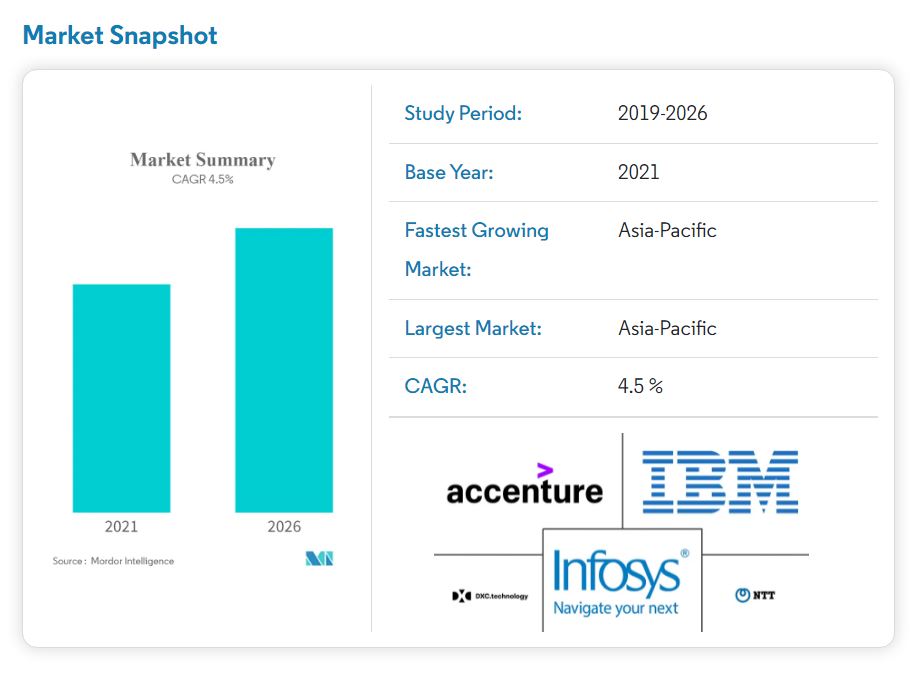
IT Outsourcing market overview. Source: Mordor Intelligence

IT Outsourcing industry market overview. Source: Mordor Intelligence


Despite, or perhaps because of the COVID-19 pandemic, the percentage of the budget IT departments spend on outsourcing will continue to rise by about 8 – 9%, based on the previous number of 2019 and 2020. Any threats and challenges of such hard time caused by the pandemic, IT Outsourcing shows great potential as it can harness the trends of digitalization and help businesses in terms of business growth, customer experience and competitive disruption.

If you want to join the fast-growing IT Outsourcing market but don’t know where to start, check out our IT Outsourcing Ultimate Guide: Definition, Types & Models, And Trends To Look Out for in 2023 to have a winning outsourcing strategy.

2. Frequently outsourced functions

According to a study from Mordor Intelligence, it is suggested that Application Development and Maintenance have become the most frequently outsourced functions amidst the partial IT outsourcing trends.

For application development, which is the most frequently outsourced function, 37% of organizations that outsource this function are planning to increase the amount of work they outsource. Application development continues to take larger parts of the IT budget, and many IT organizations are looking to optimize internal staffing through the selective use of outside development firms.

Maintenance ranks the second most frequently outsourced IT functions, as many businesses now need the most updated technology and flawless operations on their application. As a result, maintenance comes in and brings about many benefits such as Bug Fixation, Capability Enhancement, Performance Improvement, Scalability and security.


3. Sectors to outsource to most

BFSI (Banking, financial services and insurance) is the sector that accounts for the largest market share of the IT Outsourcing industry.

As modern customers are now more demanding in how the services are delivered to them, businesses in the BFSI sector have come to technological applications for a more personalized and streamlined customer experience.

Moreover, the implementation of technology in customer experience not only provides top-notch customer service but also gives the businesses the tool to harness and mine the data from their customers, bringing about the great potential for business growth.

Other sectors that make the list is Healthcare, Shipping & Transportation, Retail & Manufacturing.


4. What countries to outsource the most

As the pandemic accelerated global businesses, companies are making every effort to implement digitalization into their operations. Among the developed countries, the US, which has a mature economy, is leading in the number of outsourced services in the world, with 68% of companies delegating their services.
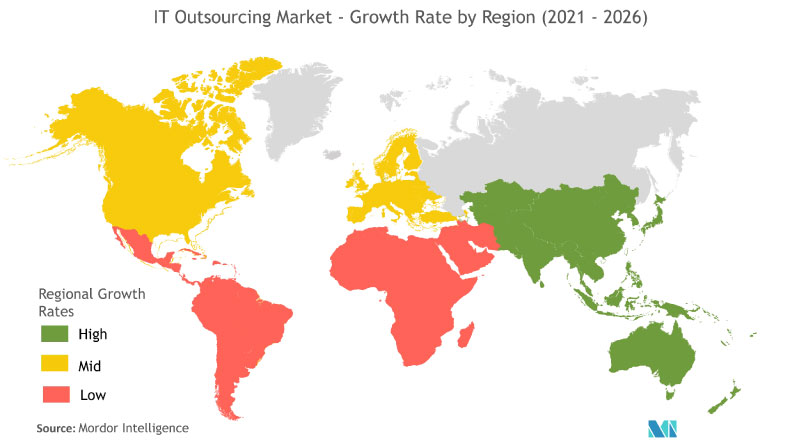
IT Outsourcing market by region. Source: Mordor Intelligence

IT Outsourcing industry by region. Source: Mordor Intelligence


Ranks second in this is the UK, with 48% of companies are outsourcing offshore with talent shortage as the main factor.

Since the cost to hire a competent IT worker in these developed countries is very high, the need to come to cheaper countries is higher, hence the majority of countries that outsource the most lie in the developed countries. Another country to make to list is Japan, with 43% of companies outsourcing their services.


5. Global IT outsourcing destinations

India and China are leading the outsourcing bandwagon, followed by Indonesia, Malaysia, Belarus, the Philippines and Vietnam due to their cheap labor and operating costs. Especially in Vietnam, IT Outsourcing in Vietnam has emerged with $11.0B in revenue (according to a report by the Vietnam Software and IT Services Association). Vietnam also ranked 9th in Tholon’s Top 50 Digital Nations. The total ICT export is reported to be $91.5B, bringing $3.5B of software export turnover. This number is predicted to grow more in 2022.

While these destinations will continue to grow sustainably, Eastern and Western Europe have emerged as credible outsourcing destinations in recent years. A few other Eastern European countries are fast-growing destinations for offshore IT solutions due to advanced technology and robust infrastructure.

Also read: Top 8 IT outsourcing countries

Upcoming trends of the IT Outsourcing market

1. Remote work continues

Although the pandemic is receding, there’s little sign of working practices returning to pre-COVID ‘normal.’ And while it’s here to stay, remote working might not continue in the same way.

In the UK, for example, 36% of employees did some work at home in 2020 – up 9% in 2019. In the US, where only 7% of employees could regularly work from home before the pandemic, 36% said they did some telework because of it.

 

IT Outsourcing market - Remote work will continue

IT Outsourcing industry market – Remote work will continue


It’s impossible to say definitively what the coming year will hold, but the steps organizations are taking give us an idea of what’s to come. Several high-profile organizations have enthusiastically embraced remote working, and like it so much they’re making it the default setting.

  • US insurer Nationwide has announced plans to reduce its 20 offices to four
  • In 2020, Shopify announced that it is a ‘digital by default company’ and that most of its staff will permanently work remotely
  • Dropbox is becoming a virtual-first company, with remote work being the default
  • LinkedIn will allow people to choose full-time remote work or a hybrid option


2. South-east Asia as the top destination for IT outsourcing

As most of the top destinations for IT Outsourcing in the world such as Indonesia, Malaysia, the Philippines and Vietnam are in Southeast Asia, this region will be the

To demonstrate just how attractive these markets are, the 2017 A.T. Kearney Global Services Location Index ranked the Philippines, Indonesia, and Vietnam in the top ten for outsourcing in the business environment, financial attractiveness, people skills, and availability of workforce.


3. Positions to be outsourced

Overall, software development will be of higher demand, with Back End developers, Front End developers, Full Stack Developers, Mobile Developers, QA Testers and UX/UI Developers being the most sought-after. However, the key technologies needed will be in Cloud computing, Blockchain, and Cybersecurity.

  • Cloud computing: In 2018 alone, companies invested approximately $ 175.8 billion in cloud computing infrastructure and services worldwide, more and more jobs in Cloud technology will be in demand.
  • Blockchain: This technology has been around for years, but it was Bitcoin that brought the idea to mainstream attention when this cryptocurrency became the first to use the blockchain as its underlying platform.
  • Cybersecurity: Hacking, cyberattacks and data breaches are now commonplace in today’s digital world. In fact, The number of connected IoT devices has increased by 9%, reaching a total of 12.3 billion worldwide.

 

IT Outsourcing market - Positions to be outsourced

IT Outsourcing industry – Positions to be outsourced


With the ever-changing market as of today, the IT Outsourcing industry has many to offer with an unprecedented growth rate and potential. As technology is the core of our enhancements, IT Outsourcing is sure to boom in the future. If you want to hear more about this industry and figure out how your business can harness the potential of tech through outsourcing, please contact Lotus QA for further information.

3. A shift from a single vendor to an ecosystem of third-party relationships.

Instead of accessing limited technology, and talent pool when working with only one vendor, stakeholders tend to cooperate with a slew of IT outsourcing providers to be less dependent on one vendor and better risk mitigation.

4. Outsourcing has been overshadowed by the prioritization of new technological advances.

Based on a recent McKinsey report on technology transformations, just 10 percent of respondents identified cost reduction as a priority. Meanwhile, 38% prioritize innovating technology to make it a competitive advantage.

The shift to prioritizing value over cost efficiencies from third-party services has accelerated the evolution toward a highly outsourced IT environment.

Explore tech trends with latest statistics to leverage the advancement in dynamic technology landscape.

Lotus QA has the expertise and experience with IT services in many domains such as retail, food and beverage, healthcare, etc., making us one trustworthy and professional service provider for businesses wanting to implement IT outsourcing. When working with us, you will get access to:

  • High Security: LQA not only follows stringent procedures of ISO 27000:01 for optimal security and international standardized process but also flexibly adapts to clients’ requirements
  • Quality Human Resource: we ensure staff competency through strict rounds of interviews, on-job orientations, and continuous learning & development for the most suitable QA staff.
  • Flexibility: We provide different working models to allow clients to choose or change the plan at any time.

Contact us for more support with automation testing services:

BlogIT Outsourcing

IT Outsourcing Vendor: What are features to consider?

When choosing the IT outsourcing vendor for your business, you are spoilt for the choices of thousands of IT service providers from all over the world. With each of the vendors claiming to be the best choice for you, there are many IT outsourcing vendor selection criteria that you have to put into consideration.

Let’s check out our article on How to choose the most suitable IT outsourcing vendor for your business.

1. Technology expertise & focused domains

For most of the time, the main reason for one business to resort to the help of a third party is the lack of technical knowledge and domain expertise. For example, an industrial manufacturing company wanting to implement digital transformation doesn’t have what it takes to build an ERP system, so they outsource the function to a renowned vendor who knows the technology and the industry. This helps save a lot of effort in building and maintaining an in-house tech team.

Concerning the technical matters, you should consider the technical expertise and the focused domains that you will work on.

Technology expertise

Technology expertise means the programming languages, the frameworks, tools, etc. that will be applied in your application. Not only that, but you will also need to identify the level of experience you want your employees to have.

For a non-tech company, identifying these matters is no easy job, but it can be easily done with the help of a technical consultant to give the most objective view of what you would need. Then, when you’ve already known the technical requirements, you can produce a job description featuring all the technical requirements and select the most suitable IT outsourcing vendor.

Focused domains

Besides the universal knowledge that every of your tech team needs to have, you should also aim for those IT vendors who understand your industry. With this being done, the outsourced team wouldn’t have to spend much time on the project requirements just to understand some terms in the field.

If they have the domain knowledge they claim to have, the time spent on getting to know the system will be shortened, hence saving your business a lot of resources and time.

2. Reference from clients, case studies, and testimonials

For the IT outsourcing industry, it is very common that some vendors are economical with the truth. They tend to paint the perfect picture of what technologies they can use, how well they can do with complicated projects, etc., making you the “easy target” for fraudulent acts.

To prevent this, you should take references from clients, actual case studies and testimonials. Of course, the vendors will always want to direct you to their website so that you will see what they want you to see. Even though it’s good to know what they can put on the table, but it is also a must for you to go to a review website to see the vendor’s real work.

For example, you can go to Clutch – a website that interviews real clients, collects data, and compares competitors. On this website, when a vendor wants to publish a review from their client, their client will have to log in and leave detailed information about the project, including the position that the client holds, the project, the ratings they want to give for different criteria namely cost, flexibility, etc.

Besides, you can also ask for the case studies of the IT outsourcing vendor for that one particular part you want to outsource. Ask for the details of the projects, what challenges and how they overcame them. With all of these, you can now grasp a sense of how they deal with potential problems and their solutions.

3. Reasonable hourly rate

According to a survey from Deloitte, recent years have witnessed a sharp increase in the number of organizations giving priority to cost reduction. With a clear vision and focus on the cost, it is vital that you consider the vendors that have a reasonable hourly rate.

With IT Outsourcing, many businesses have to choose between hiring a domestic vendor and a foreign vendor. While the domestic vendor can offer closer proximity, better managerial presence and better communication, the foreign one’s biggest advantage lies in the cost. Therefore, to optimize spending, it is advisable that you consider offshore/nearshore vendors. For example, you’re a business in the US, so you can consider vendors from India, Ukraine, and Vietnam.

Take a look at the average wage for IT workers in these countries to see how much you can save when choosing them:

Countries Rates
Ukraine, Romania, Poland, Bulgaria, Hungary, Czech Republic, Slovakia, Belarus $25-$50
Argentina, Brazil, Mexico, Colombia, Peru, Chile $30-$50
South Africa, Morocco, Kenya, Nigeria, Egypt $20-$40
India, China, Indonesia, Philippines, Vietnam, Pakistan, Malaysia, Bangladesh $18-$40

Choosing vendors with reasonable hourly rates does not simply mean choosing the ones that offer the lowest rates. You also have to consider many other factors, such as budget coherence, their prestige, their commitment, employee competency to decide.

Related posts

Top 8 IT Outsourcing Countries

Top outsourcing companies in Vietnam

4. Favorable service policy

Another important factor for you to consider is the service policy that the vendor is willing to offer. This can be shown through their flexibility and cost-sharing policies.

Flexibility

It is very common that your process or your requirements don’t match the service offering that the vendors follow. If that’s the case, you should go for the vendors that can adjust themselves to align with your operations. By working with a vendor that is willing to do this, you will not have to spend a lot of time adapting.

Flexibility is also shown in how the vendors offer the engagement model. Each vendor will have its main models, but only some of them are ready to change their way of working to meet your needs. Stick to these vendors because their willingness to adhere to you shows how important you are to them.

Cost-sharing policies

When working with an external party, it is often the case that you are hindered by numerous hidden costs. For example, an embedded testing center has to import these specific electronic devices from a foreign country to carry out testing. The cost to transport and move the devices from one country to another can be very costly, and many vendors will charge you more for this.

However, with those vendors that have cost-sharing policies, they will be responsible for the transport fee in their countries, all you have to take care of is the fee for delivering them to the vendor’s place. Please be noted that not every vendor can offer you these cost-sharing policies. Therefore, you have to look very carefully and ask for the details of how much they can help you save.

5. Location, time zone & culture

The location of the outsourcing service providers can affect greatly how the project will operate in the future. When it comes to IT Outsourcing, you can either hire a local team or the remote team (which can be offshore). With different choices, you will have different approaches and management methods.

For example, in case of emergencies that require close-up management and direct check-up from the vendor, a closer vendor would save up the time and travel costs.

In terms of time zone, you should choose those IT vendors that can easily set up meetings and provide answers quickly. Any problems or issues can be addressed immediately without any delay. Choosing the countries with opposite time zone is not very ideal, unless you can save a lot of money with them.

Culture is another feature that you need to take into consideration, as it can immensely affect team morale and possibly team performance. Cultural differences lead to crashes in how the team works and communicates with each other. If an issue cannot get delivered and handled with cultural awareness, it is very much likely to fail, leading to a derailed project.

6. Strict process

A strict process can help you make sure that every operation and function from both parties go hand in hand. As a result, you can also streamline the project’s objectives, hence achieving the desired results.

Choose the right IT outsourcing vendors that can strictly adhere to the agreed work process. With this being done, every activity of your project will be turned into a cognitive part of the well-oiled machine in which any problems will have a protocol to deal with.

Besides the working process, you also need to find those that can produce a detailed security process. This security process is considered a blueprint of what to do and why it is necessary to achieve robust security. A security process makes the employees from both the clients and vendors comply with certain steps and rules, which will eventually ensure that everything is carried out as scheduled.

Lotus QA as a trusted IT Outsourcing vendor

Lotus QA has the expertise and experience with IT services in many domains such as retail, food and beverage, healthcare, etc., making us one trustworthy and professional service provider for businesses wanting to implement IT outsourcing. When working with us, you will get access to:

  • High Security: LQA not only follows stringent procedures of ISO 27000:01 for optimal security and international standardized process but also flexibly adapts to clients’ requirements
  • Quality Human Resource: we ensure staff competency through strict rounds of interviews, on-job orientations, and continuous learning & development for the most suitable QA staff.
  • Flexibility: We provide different working models to allow clients to choose or change the plan at any time.

Contact us for more support with IT outsourcing vendor:

  • Website: https://www.lotus-qa.com/
  • Tel: (+84) 24-6660-7474
  • Fanpage: https://www.facebook.com/LotusQualityAssurance